Bank Capital Ratios Explained: CET1, Tier 1 & More
Capital is the cushion that stands between a bank and failure. This guide explains the four regulatory capital ratios (CET1, Tier 1 risk-based, total risk-based, and Tier 1 leverage), the …
Capital is the first and last line of defense for any bank. It is the shareholder money and retained earnings that absorb losses when loans go bad, when investments decline in value, or when the economy turns. When a bank fails, it is almost always because its capital was exhausted before its problems were. That is why capital ratios sit at the center of bank regulation, and why every analyst, examiner, and informed depositor should understand how to read them.
This guide explains the four capital ratios that regulators track, what each one measures, the thresholds that define a “well-capitalized” bank, and how to interpret them in practice.
Why Banks Are Required to Hold Capital
Banks are highly leveraged by design. They fund a large book of loans and securities with a comparatively thin slice of their own capital and a large base of deposits and borrowings. That leverage is what makes banking profitable, and what makes it fragile. If the value of a bank’s assets falls by even a few percent, it can wipe out the equity cushion entirely.
Capital requirements force banks to hold enough loss-absorbing equity that they can withstand a reasonable degree of stress without becoming insolvent or unable to repay depositors. Regulators express these requirements as ratios: capital measured against the bank’s assets, with riskier assets carrying more weight. These requirements are set by the federal banking agencies, including the OCC.
Risk-Weighted Assets: The Foundation
Three of the four capital ratios are measured against risk-weighted assets (RWA) rather than raw total assets. The idea is that not all assets are equally risky, so they should not all require the same capital.
Under the standardized approach, assets are assigned risk weights:
- 0%: cash and U.S. Treasury securities
- 20%: many government-sponsored agency securities and claims on U.S. banks
- 50%: certain residential mortgages
- 100%: most commercial loans and corporate exposures
- 150%: certain past-due loans and high-volatility commercial real estate
A bank holding $100 million in Treasuries carries far less required capital than one holding $100 million in commercial loans, because the Treasuries carry a 0% weight and the commercial loans carry 100%. Risk-weighting is what allows regulators to compare capital adequacy across banks with very different balance sheets.
The Four Capital Ratios
1. Common Equity Tier 1 (CET1) Ratio
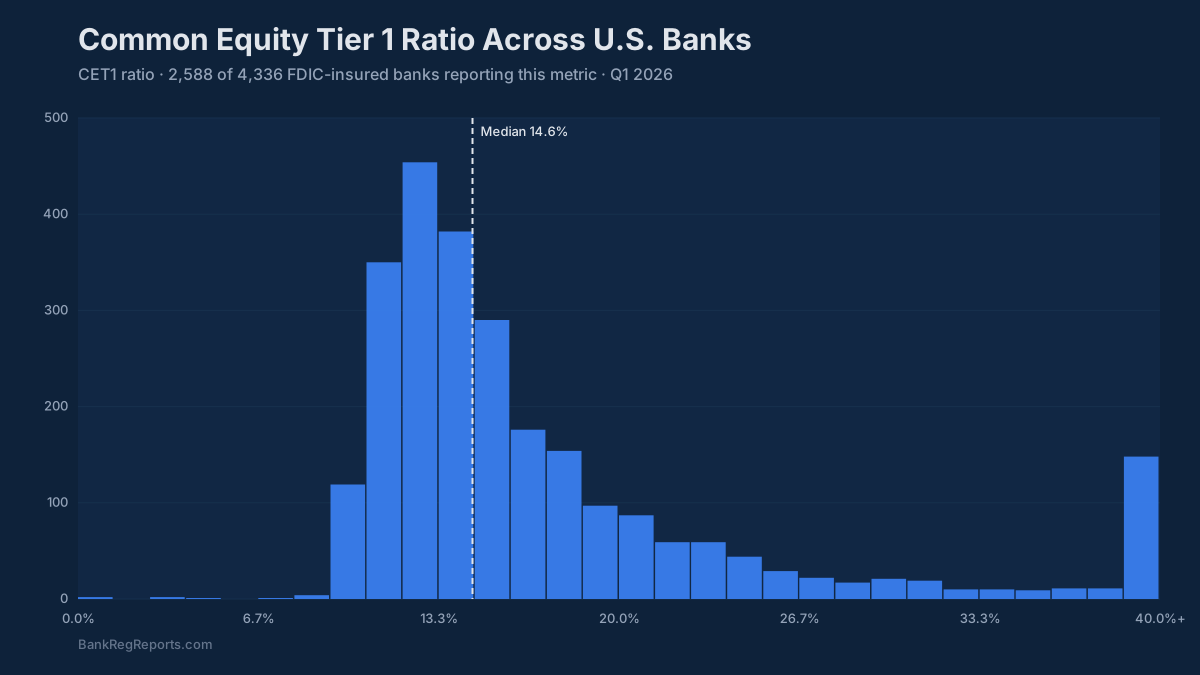
CET1 is the highest-quality capital, common stock and retained earnings, the purest form of loss absorption. The CET1 ratio divides this core capital by risk-weighted assets.
CET1 Ratio = Common Equity Tier 1 Capital ÷ Risk-Weighted Assets
Because CET1 excludes preferred stock, subordinated debt, and other hybrid instruments, it is the ratio regulators and markets watch most closely. It answers the question: how much truly permanent, loss-absorbing equity does this bank have relative to its risk?
2. Tier 1 Risk-Based Capital Ratio
Tier 1 capital is CET1 plus “additional Tier 1” instruments such as certain non-cumulative perpetual preferred stock. The Tier 1 ratio divides this broader measure of core capital by risk-weighted assets.
Tier 1 Ratio = Tier 1 Capital ÷ Risk-Weighted Assets
3. Total Risk-Based Capital Ratio
Total capital adds “Tier 2” capital (supplementary instruments such as qualifying subordinated debt and a portion of the loan loss allowance) to Tier 1. It represents the widest definition of regulatory capital.
Total Capital Ratio = (Tier 1 + Tier 2 Capital) ÷ Risk-Weighted Assets
4. Tier 1 Leverage Ratio
The leverage ratio is the odd one out: it measures Tier 1 capital against average total assets, not risk-weighted assets. By ignoring risk weights entirely, it acts as a backstop against banks that load up on assets regulators deem “low-risk” but which can still produce losses.
Tier 1 Leverage Ratio = Tier 1 Capital ÷ Average Total Consolidated Assets
The 2023 failures were a reminder of why this backstop exists: large holdings of “safe” government securities carried low risk weights but generated substantial unrealized losses when interest rates rose.
The Well-Capitalized Thresholds
U.S. regulators sort banks into capital categories under the Prompt Corrective Action (PCA) framework. To be considered well-capitalized, the top category, a bank must meet all of the following:
| Ratio | Minimum required | Well-capitalized |
|---|---|---|
| CET1 ratio | 4.5% | 6.5% |
| Tier 1 risk-based ratio | 6.0% | 8.0% |
| Total risk-based ratio | 8.0% | 10.0% |
| Tier 1 leverage ratio | 4.0% | 5.0% |
On top of the minimums, most banks must hold a capital conservation buffer of an additional 2.5% in CET1, which effectively raises the operational CET1 minimum to about 7.0%. The largest firms carry a further surcharge calibrated from the FR Y-15 systemic risk indicators. Banks that dip into the buffer face restrictions on dividends and bonus payments. (Sources: Congressional Research Service: Bank Capital Requirements; OCC Quick Reference Guide for Community Banks.)
Falling below the well-capitalized line does not mean a bank is failing, but it escalates supervisory attention. As ratios decline through “adequately capitalized,” “undercapitalized,” and below, regulators gain progressively stronger powers to compel corrective action.
The Community Bank Leverage Ratio (CBLR)
To reduce the compliance burden on smaller institutions, qualifying community banks can opt into the Community Bank Leverage Ratio framework. A qualifying community bank (generally one with under $10 billion in total assets, limited off-balance-sheet exposures, and limited trading activity) that maintains a leverage ratio above the CBLR threshold is deemed to satisfy all capital requirements and is considered well-capitalized, without having to calculate risk-weighted assets at all.
The threshold is a leverage ratio greater than 8%. A qualifying community bank that keeps its leverage ratio above 8% is deemed to satisfy the risk-based and leverage capital requirements and is considered well-capitalized, without calculating risk-weighted assets. The agencies lowered the threshold from 9% to 8% in a final rule published April 29, 2026 and effective July 1, 2026, which also lengthened the grace period for a bank that slips below it from two quarters to four, provided the leverage ratio stays above 7%. (The threshold was also temporarily 8% in 2020 under the CARES Act, before phasing back to 9% by 2022.)
When you analyze a small bank, check whether it reports under the CBLR; it changes which ratios are most meaningful for that institution.
How to Read Capital Ratios in Practice
A few principles separate a surface read from a useful one:
Look at all four together. A bank can post a strong total capital ratio while its CET1 ratio, the higher-quality measure, is thinner. The gap reveals how much the bank leans on preferred stock and subordinated debt versus pure equity.
Watch the trend. A bank with declining capital ratios over several quarters, even while still above well-capitalized thresholds, may be consuming capital faster than it generates it. The trajectory often matters more than the current level.
Compare against peers. A 12% CET1 ratio means one thing if peers average 11% and another if they average 15%. The UBPR’s peer-group framework makes this comparison straightforward, and capital adequacy is the “C” in the CAMELS rating examiners assign.
Mind the risk-weighting. Two banks with identical leverage ratios can have very different risk-based ratios depending on their asset mix. Always read the leverage ratio and the risk-based ratios side by side.
How BankRegReports Makes Capital Analysis Easier
Every capital ratio discussed here is reported in Schedule RC-R of the call report and standardized in the UBPR. BankRegReports pulls these figures for all U.S. banks, charts them across 24+ years of quarterly history, overlays the regulatory thresholds so you can see the cushion at a glance, and lets you benchmark any bank against a custom peer group. Whether you are preparing for an examination, building a board packet, or evaluating a counterparty, the capital picture is one click away.
Frequently Asked Questions
What does it mean for a bank to be “well-capitalized”? A bank is well-capitalized when it meets all four regulatory thresholds: a CET1 ratio of at least 6.5%, a Tier 1 risk-based ratio of at least 8.0%, a total risk-based ratio of at least 10.0%, and a Tier 1 leverage ratio of at least 5.0%. Well-capitalized is the highest category under the Prompt Corrective Action framework.
What is the difference between CET1 and Tier 1 capital? CET1 (Common Equity Tier 1) is the highest-quality capital, mainly common stock and retained earnings. Tier 1 capital is broader: it equals CET1 plus additional Tier 1 instruments such as certain perpetual preferred stock. All CET1 is Tier 1, but not all Tier 1 is CET1.
What is the difference between the leverage ratio and risk-based ratios? The Tier 1 leverage ratio measures capital against average total assets and ignores risk weighting. The risk-based ratios (CET1, Tier 1, and total) measure capital against risk-weighted assets, giving more credit for holding lower-risk assets. The leverage ratio acts as a backstop.
What are risk-weighted assets? Risk-weighted assets are a bank’s assets adjusted for their relative riskiness. Safer assets like U.S. Treasuries carry a 0% weight, while most commercial loans carry a 100% weight. Capital is measured against this risk-adjusted total rather than raw assets.
What is the capital conservation buffer? The capital conservation buffer is an additional 2.5% of CET1 capital that most banks must hold above the regulatory minimums. It effectively raises the operational CET1 minimum to about 7.0%. Banks that fall into the buffer face restrictions on dividends and discretionary bonus payments.
Where can I find a bank’s capital ratios? Capital ratios are reported in Schedule RC-R of every bank’s quarterly call report and standardized in the UBPR. BankRegReports displays them for all U.S. banks with historical trends, regulatory thresholds, and peer comparisons.