The NCUA 5300 Call Report: A Credit Union Guide
Credit unions file their own quarterly report — the NCUA 5300 — and it works much like a bank call report, with a few important differences in language and capital. …
Banks are not the only depository institutions that file detailed quarterly financials. The roughly 4,300 federally insured credit unions in the United States file their own version — the NCUA 5300 Call Report — with the National Credit Union Administration. It mirrors the bank call report in spirit and structure, but credit unions are different kinds of institutions, and their reporting carries its own vocabulary and its own capital framework. If you analyze credit unions, the 5300 is where the data lives.
This guide explains what the NCUA 5300 Call Report is, how credit union reporting differs from bank reporting, and how to analyze a credit union’s health.
What Is the NCUA 5300 Call Report?
The NCUA 5300, formally the Call Report, is the quarterly financial and statistical filing that every federally insured credit union submits to the National Credit Union Administration through NCUA’s online portal. It captures the credit union’s balance sheet, income statement, capital, delinquency, and membership data — the foundation for the NCUA’s supervision and for all public credit union financial analysis.
Like the bank call report, the 5300 is standardized, filed every quarter, and publicly available, which makes credit unions directly comparable to one another across the entire system. As of December 31, 2025, there were 4,287 federally insured credit unions filing the 5300. (Source: NCUA: Credit Union and Corporate Call Report Data.)
Credit Unions vs. Banks: The Core Differences
Credit unions and banks both take deposits and make loans, but they are fundamentally different institutions, and that difference shapes their reporting:
- Ownership and purpose. Credit unions are not-for-profit, member-owned cooperatives. Banks are for-profit, shareholder-owned. A credit union’s “customers” are its member-owners.
- Regulator and insurer. Credit unions are supervised by the NCUA and insured by the National Credit Union Share Insurance Fund (NCUSIF), not the FDIC — though the coverage limit is the same $250,000 per member.
- Tax status. Credit unions are generally exempt from federal income tax, which affects how their earnings are interpreted.
- Terminology. Credit union reporting uses different words for similar concepts (see below).
These differences mean you cannot read a credit union’s 5300 with exactly the same lens as a bank’s call report — but the analytical principles carry over.
Translating the Vocabulary
Much of the confusion in moving between bank and credit union analysis is just language. The underlying concepts line up closely:
| Bank term | Credit union equivalent |
|---|---|
| Deposits | Shares / share deposits |
| Borrowers’ loans | Member loans |
| Shareholders’ equity | Members’ equity / net worth |
| Net income | Net income (no tax line for most) |
| Customers | Members |
| Dividends to shareholders | Dividends/interest to members on shares |
Once you map the vocabulary, the balance sheet and income statement read much like a bank’s: assets funded by member shares and some borrowings, income driven by the spread between loan yields and the cost of shares, and profitability measured by return on average assets.
The Net Worth Ratio: The Credit Union Capital Measure
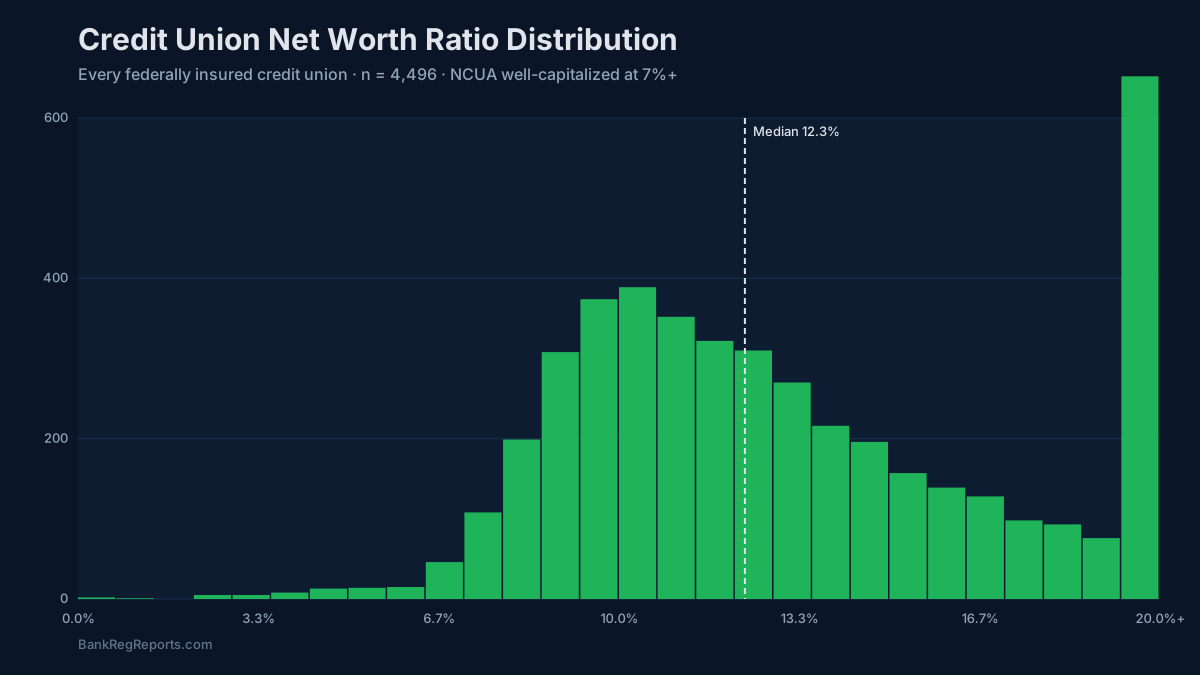
The single most important capital concept unique to credit unions is the net worth ratio. Because credit unions cannot raise equity by issuing stock — they build capital almost entirely through retained earnings — regulators measure their capital adequacy primarily through net worth as a percentage of total assets.
Net Worth Ratio = Net Worth ÷ Total Assets
Under the NCUA’s prompt corrective action framework, a credit union is generally considered “well capitalized” at a net worth ratio of 7% or above, with lower thresholds triggering progressively greater supervisory attention — conceptually parallel to the leverage ratio and PCA categories that apply to banks. When you assess a credit union’s capital strength, the net worth ratio is the number to anchor on.
How to Analyze a Credit Union
Despite the differences, the analytical playbook largely mirrors bank analysis, applied to 5300 data:
- Capital: the net worth ratio and its trend.
- Asset quality: the loan delinquency ratio and net charge-offs on member loans.
- Earnings: return on average assets and the net interest (and fee) spread.
- Liquidity and funding: the loan-to-share ratio (the credit union analog of loan-to-deposit) and reliance on borrowings.
- Growth: membership, share, and loan growth, which signal franchise health.
As with banks, the trend over time and the comparison against peer credit unions of similar size and field of membership matter more than any single absolute figure.
How BankRegReports Helps with Credit Union Analysis
The NCUA 5300 data is public, but turning quarterly filings into trends and peer comparisons takes work. BankRegReports brings credit union and bank data together, letting you search any federally insured credit union, view its net worth ratio, asset quality, earnings, and loan-to-share metrics charted across years of quarterly history, and benchmark it against peer institutions. Whether you are a credit union executive benchmarking performance, an analyst covering the sector, or a member checking on your institution, the 5300 data becomes far more useful when it is visualized and put in peer context.
Start for free — no credit card required →
Frequently Asked Questions
What is the NCUA 5300 Call Report? The NCUA 5300 Call Report is the quarterly financial and statistical filing that every federally insured credit union submits to the National Credit Union Administration. It captures the credit union’s balance sheet, income statement, capital, delinquency, and membership data and is the basis for NCUA supervision and public credit union analysis.
How is a credit union call report different from a bank call report? Both are standardized quarterly filings, but credit unions are not-for-profit, member-owned cooperatives supervised by the NCUA and insured by the NCUSIF rather than the FDIC. Credit union reporting uses different terminology — shares instead of deposits, members instead of customers, net worth instead of shareholders’ equity — and centers capital on the net worth ratio.
Who files the NCUA 5300? All federally insured credit unions file the NCUA 5300 quarterly through the NCUA’s online portal. As of December 31, 2025, there were 4,287 federally insured credit unions.
What is the net worth ratio for a credit union? The net worth ratio equals a credit union’s net worth divided by its total assets. Because credit unions build capital mainly through retained earnings, it is the primary measure of capital adequacy. Under the NCUA’s prompt corrective action framework, a ratio of 7% or above is generally considered well capitalized.
Are credit unions insured like banks? Yes. Federally insured credit unions are covered by the National Credit Union Share Insurance Fund (NCUSIF), administered by the NCUA, with the same $250,000 per-member coverage limit that the FDIC provides for bank deposits.
Where can I find a credit union’s 5300 data? NCUA 5300 data is publicly available through the NCUA. BankRegReports also presents credit union financials with net worth, asset quality, earnings, and loan-to-share metrics, historical trends, and peer comparisons.