Bank Failures and the FDIC Problem Bank List: What the Data Shows
Silicon Valley Bank had a tangible common equity ratio that had been declining for six quarters before March 2023. The concentration in long-duration securities was disclosed every quarter in Schedule …
Silicon Valley Bank had a tangible common equity ratio that had been declining for six quarters before March 2023. The concentration in long-duration securities was disclosed every quarter in Schedule RC-B of its FFIEC 041. The uninsured deposit percentage sat above 90% — visible in Schedule RC-E. None of that was secret. The failure looked sudden from the outside because most people weren’t reading the call report.
Bank failures almost never happen overnight. Capital erodes over quarters. Bad loans accumulate through cycles. Funding weakens incrementally. By the time the FDIC closes a bank on a Friday afternoon, the financial trajectory has usually been obvious for anyone reading the public data. Understanding how that trajectory unfolds — and how the regulatory early-warning system is structured — is the starting point for doing serious bank safety analysis.

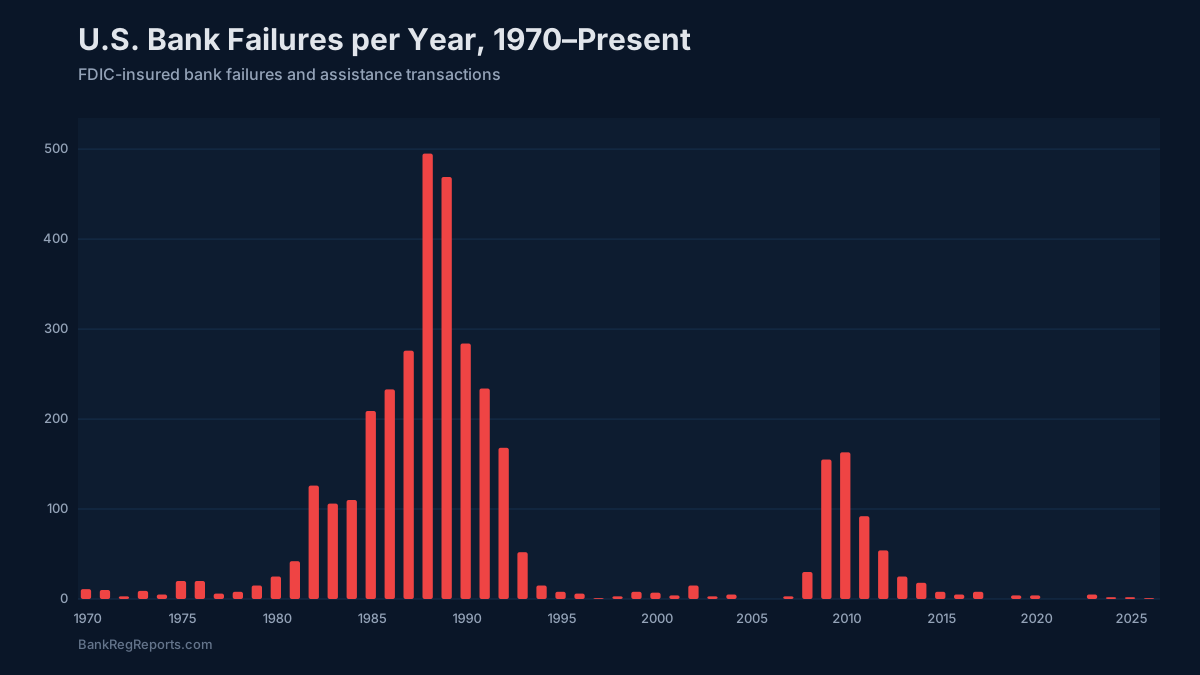
The two great failure waves stand apart from everything else. The S&L crisis ran from roughly 1985 through 1992 and peaked at 221 failures in 1988. The 2008–2010 financial crisis peaked at 157 in 2010. The 2023 regional-bank stress, by contrast, produced only five failures — but two of them (SVB and First Republic) were among the largest bank failures in U.S. history by assets.
How a Bank Actually Fails: Two Paths, Usually Together
A bank fails when it can no longer meet its obligations. In practice that happens through insolvency, illiquidity, or — most commonly — both at once.
Insolvency is a capital failure. Losses from bad loans or investment write-downs consume the bank’s equity faster than retained earnings can replace it. Regulators track this through the Prompt Corrective Action framework: banks fall through the capital categories from “well capitalized” to “adequately capitalized” to “undercapitalized” to “significantly undercapitalized” to “critically undercapitalized.” Once a bank reaches critically undercapitalized — generally a Total Risk-Based Capital ratio below 2% (RCON7204 / RCONA223 depending on the form) — the FDIC is required to act within 90 days.
Illiquidity is a funding failure. A bank that cannot fund withdrawals is forced to sell assets at a loss, which erodes capital, which triggers more withdrawals. Even a technically solvent bank can be destroyed by this dynamic. SVB’s collapse in 2023 ran from disclosure of securities losses to receivership in roughly 48 hours — the speed made possible by instant digital transfers and social media coordination. The underlying vulnerability had been accumulating for two years.
When a bank fails, the FDIC is typically appointed receiver. Insured deposits — up to $250,000 per depositor, per bank, per ownership category — are protected, usually by a purchase-and-assumption transaction where another bank assumes the deposits and most assets. Uninsured depositors are creditors of the receivership and may or may not recover the balance above the limit. That asymmetry is precisely why the composition of a bank’s deposit base matters to its stability: the higher the uninsured percentage (Schedule RC-E, RCON2711 / RCON5597), the more vulnerable the institution is to a confidence-driven run.
The FDIC Problem Bank List: What It Is and What It Isn’t
The “problem bank list” is the FDIC’s internal tally of insured institutions with a composite CAMELS rating of 4 or 5 — the two weakest categories on the supervisory rating scale, reflecting serious weaknesses that examiners believe threaten the bank’s continued viability.
The list is confidential in its specifics. The FDIC publishes the count and aggregate assets of problem banks each quarter in its Quarterly Banking Profile. It does not name the institutions. The logic is straightforward: naming a bank as a problem bank could cause depositors to flee, accelerating the very failure the disclosure is meant to prevent. The confidentiality is a deliberate feature of the system.
The count itself is a useful stress gauge. As of Q4 2025, the FDIC reported 60 problem banks — approximately 1.4% of all insured institutions, within the agency’s stated normal range of 1%–2% for non-crisis periods. During the 2010 peak, the list held 884 institutions with nearly $400 billion in aggregate assets. That difference in magnitude tells you something about the relative severity of the two periods that the failure count alone doesn’t capture, because many institutions in 2010 were impaired but ultimately survived.
A bank can be on the problem list and survive. Many do. The list measures identified risk, not certain failure.
What Lands a Bank on the Problem Bank List: CAMELS
CAMELS — Capital adequacy, Asset quality, Management, Earnings, Liquidity, Sensitivity to market risk — is the framework examiners use to assign a composite rating of 1 (strongest) through 5 (weakest). A composite 4 or 5 puts the bank on the problem list. The rating is assigned during examination and updated between exams by off-site monitoring.
The rating is confidential, which frustrates people who want a simple answer about whether a specific bank is at risk. But the financial inputs to the CAMELS components are mostly public — filed quarterly in the call report (FFIEC 031/041/051) and summarized in the UBPR. What examiners are doing when they assign a CAMELS rating is essentially a structured interpretation of data that any analyst can pull.
The Warning Signs in Public Data
You cannot see the CAMELS rating. You can see most of what drives it.
Capital ratios on a downward slope. The Common Equity Tier 1 ratio (RCONA223 / RCON7204), the Tier 1 leverage ratio (RCONA204), and the Total Risk-Based Capital ratio (RCONA210) are reported quarterly. A bank falling from “well capitalized” toward the minimums is losing its regulatory buffer. Watch the direction and pace of change, not just the current level.
Asset quality deterioration. The nonperforming loan ratio (nonaccrual loans plus loans 90+ days past due, divided by total loans), net charge-offs (RIAD4635 minus RIAD4605, annualized), and the allowance coverage ratio are the core measures. Schedule RC-N reports past-due and nonaccrual loans in detail. A bank where NPLs are climbing and the reserve coverage is falling is in a worse position than the headline ratio suggests.
The Texas Ratio. Nonperforming assets divided by tangible common equity plus loan loss reserves. When this ratio approaches 100%, the bank’s loss-absorbing cushion is roughly equal to its problem assets. Historically, a Texas Ratio above 100% has been strongly associated with failure. It is blunt, but it is also fast to compute from public data and hard to obscure.
Earnings. A bank that cannot earn its way back is eroding capital by operating. Return on assets below zero (RIAD4340 divided by average assets), a rising efficiency ratio, and shrinking net interest margin are all warning signs on their own. Combined, they describe a bank that is generating losses it cannot absorb.
Funding. Heavy reliance on uninsured deposits, brokered deposits (RCON2365), or Federal Home Loan Bank advances (RCON2651) as a percentage of total funding creates concentration risk. The 2023 failures were a case study: concentrated, uninsured, operationally interconnected deposit bases that moved as a single block when confidence broke.
No single metric is decisive. The pattern — multiple signals deteriorating across multiple quarters — is what matters.

The acceleration in both series tends to become visible three to four quarters before failure. By then it is usually too late for the bank to recover without external capital or a merger. The useful analysis happens in the six to eight quarters before that point — when the trajectories are declining but not yet critical.
Pulling This Data Yourself
The BankRegReports Data API gives direct access to all the metrics above, for every FDIC-insured bank, going back to 2001. Here is a minimal example pulling capital and asset quality data for a specific institution using the BankRegAPI Python SDK:
from bankregreports import BankReg

brr = BankReg("brr_your_key_here")

# Pull quarterly safety metrics for a specific bank by RSSD ID
metrics = brr.bank_metrics(
    rssd_id=488318,  # example institution
    metrics=[
        "cet1_ratio",           # RCONA223 / risk-weighted assets
        "tier1_leverage_ratio", # RCONA204
        "npl_ratio",            # (nonaccrual + 90+ past due) / total loans
        "net_charge_off_ratio", # RIAD4635 - RIAD4605, annualized
        "texas_ratio",          # NPA / (TCE + ALLL)
        "uninsured_deposit_pct" # RCON5597 / total deposits
    ],
    periods=8  # last 8 quarters
)

print(metrics.to_dataframe())
# rssd_id  period    cet1_ratio  tier1_leverage  npl_ratio  nco_ratio  texas_ratio  uninsured_pct
# 488318   2025Q4    12.4        9.8             0.82       0.21       14.3         31.2
# 488318   2025Q3    12.1        9.6             0.79       0.19       13.8         30.7
# 488318   2025Q2    11.9        9.4             0.74       0.17       13.1         29.9
# ...
The live API documentation lists the full metric catalog, including MDRM code mappings for every field.
BankRegReports charts these metrics for all FDIC-insured institutions across more than 24 years of history and benchmarks any bank against custom peer groups. The Sentry Alert feature flags when a key ratio crosses a threshold you set — which is the automated version of what off-site examiners do between exam cycles.
For Depositors: What a Failure Actually Means
If your bank fails, and your deposits are within the insured limits, the practical impact is minimal — access restored within days, usually by another bank assuming your accounts. The real exposure is uninsured balances above $250,000 per depositor, per bank, per ownership category. Those are unsecured claims against the receivership. Recovery depends on the quality of the failed bank’s assets and how quickly the FDIC can liquidate them.
The depositors who should be paying the most attention to bank safety signals are the ones with the most to lose if the FDIC can’t make them whole: businesses with operating accounts, municipalities, and any depositor running balances that regularly exceed the insurance limit.
Frequently Asked Questions
What is the FDIC problem bank list? The FDIC problem bank list is the agency’s tally of insured banks with a composite CAMELS rating of 4 or 5 — serious weaknesses that threaten the institution’s viability. The FDIC publishes the count and aggregate assets quarterly but does not disclose which banks are on it.
How many banks are on the problem bank list right now? As of Q4 2025, the FDIC reported 60 problem banks, representing about 1.4% of all insured institutions — within the agency’s stated normal range of 1% to 2% outside of crisis periods.
Why doesn’t the FDIC name the problem banks? Disclosing which banks are on the list could trigger deposit runs, accelerating the exact failures the supervisory system is designed to prevent. The FDIC releases only the aggregate count and total assets of problem institutions.
How do bank failures happen? Through insolvency (losses exhaust capital), illiquidity (withdrawals exceed the bank’s ability to fund them), or both together. When a bank fails, the FDIC is appointed receiver and protects insured deposits, typically through a purchase-and-assumption transaction with another bank.
What are the warning signs of a bank failure? Declining capital ratios, a rising nonperforming loan ratio, accelerating net charge-offs, a high or rising Texas Ratio, sustained operating losses, and heavy reliance on uninsured or wholesale funding. The pattern across multiple quarters matters more than any single data point.
Are my deposits safe if my bank fails? Deposits up to $250,000 per depositor, per insured bank, per ownership category are FDIC-insured. Access is typically restored within days. Balances above the limit are unsecured receivership claims and may not be fully recovered.
The data referenced in this post is available through the BankRegReports Data API. The BankRegAPI Python SDK (pip install bankregreports) returns clean, UBPR-validated data from FFIEC, FDIC, Federal Reserve, NCUA, and SEC EDGAR in a single call. Get a free API key →