What Is the Provision for Credit Losses — and Why It Moves Bank Earnings So Much?
In Q1 2020, U.S. banks booked a combined $54 billion in provision for credit losses — roughly ten times the prior-year quarter — before a single major credit cycle had …
In Q1 2020, U.S. banks booked a combined $54 billion in provision for credit losses — roughly ten times the prior-year quarter — before a single major credit cycle had actually materialized. Earnings collapsed on paper. A year later, many of those same banks released reserves, and their reported profits looked better than their underlying businesses warranted. The provision for credit losses did all of that. No other line on the income statement carries that kind of leverage over a bank’s reported results.
This post covers what the provision for credit losses is, how it connects to the allowance and net charge-offs, why it moves earnings so sharply, and what to look for when you think a bank is managing the number rather than reflecting reality.

The gap between those two lines tells you more about a bank’s credit posture than either number alone.
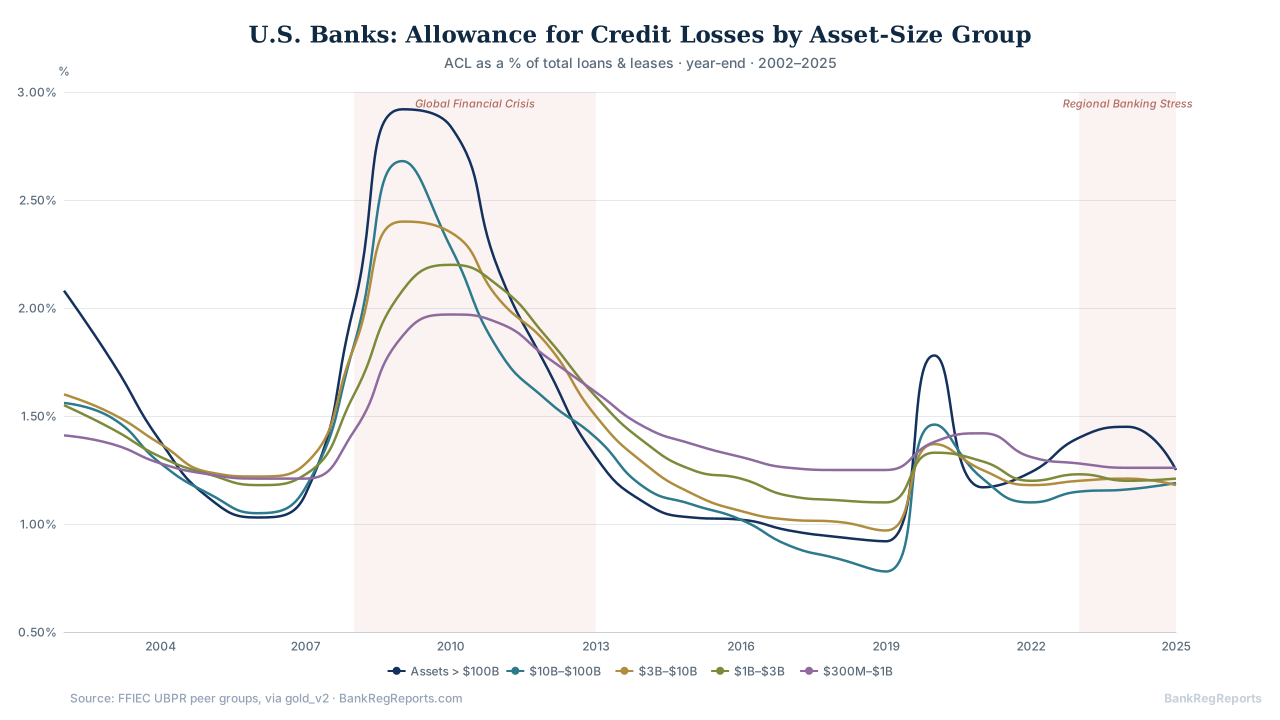
What the Provision for Credit Losses Actually Is
The provision for credit losses (RIAD4230 on the FFIEC 031/041 call report) is the income-statement expense a bank records each quarter to build or adjust the reserve it expects to need against loan losses. It is not the loss itself. The loss comes later, when a loan is charged off. The provision is the bank’s forward estimate of what it expects to lose, expensed now.
The reservoir analogy is accurate: the allowance for credit losses (RCON3123 on Schedule RC) is the balance in the tank, and the provision is what flows in each period. Net charge-offs drain it. The arithmetic is fixed:
Ending ACL = Beginning ACL + Provision − Net charge-offs
That identity matters in practice. A bank with $10M of net charge-offs and a $6M provision is running its reserve down by $4M per quarter. If you only looked at the provision, you might miss the depletion.
One thing that trips people up: the provision can go negative. A “reserve release” — when management decides the existing allowance exceeds expected losses — credits the income statement. That is real accounting income. It is also, in many cases, the most suspicious line in the earnings release.
Provision vs. Allowance vs. Charge-Offs: How They Connect
Because all three terms appear in the same analyst conversation and refer to related but distinct things, here is a precise breakdown:
Provision for credit losses — income statement, Schedule RI (RIAD4230). The period expense. Increases when expected losses rise; decreases (goes negative) when the reserve is judged excessive.
Allowance for credit losses (ACL) — balance sheet, Schedule RC (RCON3123). The cumulative reserve. This is what absorbs losses before they hit capital. Under CECL, it must reflect lifetime expected losses, not just incurred ones.
Net charge-offs — reduce the allowance directly. Gross charge-offs (RIAD4635) less recoveries (RIAD4605) on Schedule RI-B. The actual write-offs of loans deemed uncollectible.
The flow runs: provision builds the allowance; charge-offs draw it down; the provision in subsequent quarters responds to both the pace of charge-offs and changes in the forward loss estimate. A bank growing its loan book aggressively will provision simply because every new dollar of loans carries a day-one expected-loss reserve under CECL, regardless of whether any of those loans look troubled.
Why CECL Changed the Volatility Profile
Before CECL (the Current Expected Credit Loss standard), banks provisioned under an incurred-loss model — you had to demonstrate that a loss event had already occurred. That approach famously delayed recognition, which is why 2008-era reserve builds lagged the actual credit deterioration by multiple quarters.
CECL flipped the logic. Since 2020 for large banks and phased in through 2023 for smaller institutions, the allowance must capture expected losses over the remaining life of the loan portfolio, incorporating macroeconomic forecasts. The model inputs — unemployment projections, GDP forecasts, property value assumptions — mean the provision now responds to economic sentiment, not just observed delinquency.
That is a meaningful improvement for the financial system. It is also, for the analyst, a new source of noise. Two banks with identical loan portfolios can produce materially different provisions depending on which economic scenario they weight most heavily. The disclosures in the notes to financial statements (and in the MD&A section of regulatory filings) are where you find what assumptions drove the number.
How to Spot Over- and Under-Provisioning
Management has real discretion here, within the bounds of GAAP and regulatory examination. That discretion gets used — sometimes to smooth earnings, sometimes to present a more favorable credit story ahead of a capital raise or acquisition. A few checks that actually work in practice:
Provision-to-charge-off ratio over time. A bank that consistently provisions well below its charge-off rate is burning down its reserve. That cannot continue indefinitely without either a credit improvement or a large catch-up provision. The UBPR Uniform Bank Performance Report makes this comparison easy because it annualizes both metrics and benchmarks them against the peer group.
ACL coverage of nonperforming loans. Divide RCON3123 by total nonaccrual and 90+ day past due loans. Falling coverage alongside rising NPLs and a flat provision is a classic warning. Industry medians sit in the 80-130% range depending on asset class mix; a bank at 40% coverage and still cutting its provision should raise questions.
Provision as a percent of average loans versus loan growth. A bank growing its commercial real estate book 20% annually while holding provision flat is implicitly assuming the new loans carry no incremental expected loss. That may be true in a benign environment. It is harder to defend in a softening one.
Peer comparison. Pull Schedule RI data across a peer group — same asset tier, same geographic footprint, similar loan mix — and see whether one institution’s provision expense is systematically below the group. The BankRegReports Data API returns this data pre-normalized with peer medians, which saves the manual UBPR download step.

Under-provisioning to support current reported earnings is one of the oldest earnings-management techniques in banking. Examiners look for it. So do acquirers doing due diligence. The eventual catch-up provision tends to be large, sudden, and devastating to the stock.
Pulling the Data with the BankRegReports API
If you are running this analysis across a portfolio of banks, pulling call report data one UBPR PDF at a time is not a real workflow. Here is how to pull provision expense, net charge-offs, and the allowance for a specific bank using the BankRegAPI Python SDK:
from bankregreports import BankReg

brr = BankReg("brr_your_key_here")

# Pull 6 quarters of provision, NCOs, and ACL for a community bank
# rssd_id 57542 = First Busey Corporation (example)
df = brr.metrics(
    rssd_id=57542,
    codes=["RIAD4230", "RIAD4635", "RIAD4605", "RCON3123"],
    quarters=6
)

print(df)
# rssd_id  report_date  RIAD4230   RIAD4635   RIAD4605   RCON3123
# 57542    2024-09-30   4_200_000  3_100_000   890_000  41_500_000
# 57542    2024-06-30   3_800_000  2_900_000   740_000  40_800_000
# 57542    2024-03-31   3_500_000  2_750_000   710_000  40_500_000
# ...

# Derive net charge-offs and running ACL math in pandas
df["nco"] = df["RIAD4635"] - df["RIAD4605"]
df["provision_vs_nco"] = df["RIAD4230"] / df["nco"]
RIAD4230 is the provision, RIAD4635 is gross charge-offs, RIAD4605 is recoveries, RCON3123 is the allowance balance. Four codes, one call, six quarters. The endpoint is documented at api.bankregreports.com/api/v1/docs/.
Where to Find the Provision in Regulatory Filings
For bank-level entities filing the call report (FFIEC 031 for banks with foreign offices, FFIEC 041 for domestic banks, FFIEC 051 for small banks), the provision appears on Schedule RI — Consolidated Report of Income. The related allowance balance is on Schedule RC — Consolidated Balance Sheet, and the charge-off detail by loan category is on Schedule RI-B.
Holding companies file the FR Y-9C instead of the call report, and the provision maps to equivalent schedules (HI and HC). Credit unions file the NCUA 5300 Call Report, where the analogous line is the provision for loan and lease losses on the Statement of Financial Condition — same concept, slightly different naming convention.
The UBPR presents peer-normalized versions of all three metrics (provision, charge-offs, ACL coverage) and is the fastest way to put one bank in context. BankRegReports ingests the full UBPR history and exposes it via API with consistent MDRM codes, which matters when you are backtesting or building screens across the 4,500+ active filers.
Frequently Asked Questions
What is the provision for credit losses? The provision for credit losses is the expense a bank records on its income statement each quarter to build or adjust its reserve against expected loan losses. It funds the allowance for credit losses on the balance sheet and reduces current earnings when increased.
What is the difference between the provision and the allowance? The provision (RIAD4230) is the periodic income-statement expense. The allowance (RCON3123) is the cumulative balance sheet reserve. The provision flows in; net charge-offs flow out; the allowance is the running balance.
Why does the provision for credit losses make earnings volatile? Under CECL, banks must estimate expected losses over the full remaining life of their loans using economic forecasts. When the macro outlook shifts — or a bank’s loan book grows rapidly — the provision responds immediately, before any loans actually default. A large reserve build can wipe out a quarter’s operating income entirely.
Can a bank have a negative provision? Yes. When management concludes the allowance exceeds expected losses, it records a reserve release — a negative provision that credits earnings. This happens during recoveries and periods of improving credit quality. It is also the number worth scrutinizing most carefully.
How can I tell if a bank is under-provisioning? Compare provision expense to net charge-offs over rolling quarters, watch ACL coverage of nonperforming loans, and benchmark against peers with similar loan mix and geography. Systematic under-provisioning tends to leave a trail: provision below charge-offs, coverage ratios declining, and a loan book growing without a matching reserve.
Where is the provision reported? Schedule RI of the FFIEC 031/041/051 call report, RIAD4230. The FR Y-9C equivalent is Schedule HI. The UBPR standardizes and benchmarks it. BankRegReports makes all three accessible via API with full quarterly history.
The data referenced in this post is available through the BankRegReports Data API. The BankRegAPI Python SDK (pip install bankregreports) returns clean, UBPR-validated data from FFIEC, FDIC, Federal Reserve, NCUA, and SEC EDGAR in a single call. Get a free API key →