What Is CECL? The Allowance for Credit Losses, Explained
In Q1 2020, JPMorgan Chase posted a $6.8 billion provision for credit losses — up from $1.5 billion the prior quarter. The bank's loan portfolio had not yet deteriorated. The …
In Q1 2020, JPMorgan Chase posted a $6.8 billion provision for credit losses — up from $1.5 billion the prior quarter. The bank’s loan portfolio had not yet deteriorated. The charge came from CECL forcing management to book their forward estimate of lifetime losses on the entire portfolio the moment the economic outlook shifted. That is the mechanism in a single data point: reserves move on expectations, not evidence.
CECL — the current expected credit losses standard — is the most significant change to bank loss accounting since the savings-and-loan crisis. Every analyst reading a bank’s call report needs to understand how the allowance for credit losses works under it, because the numbers mean something different now than they did before 2020.

The 2020 reserve build looks like a pandemic response. It was partly that — but for large banks, it was also CECL day one.
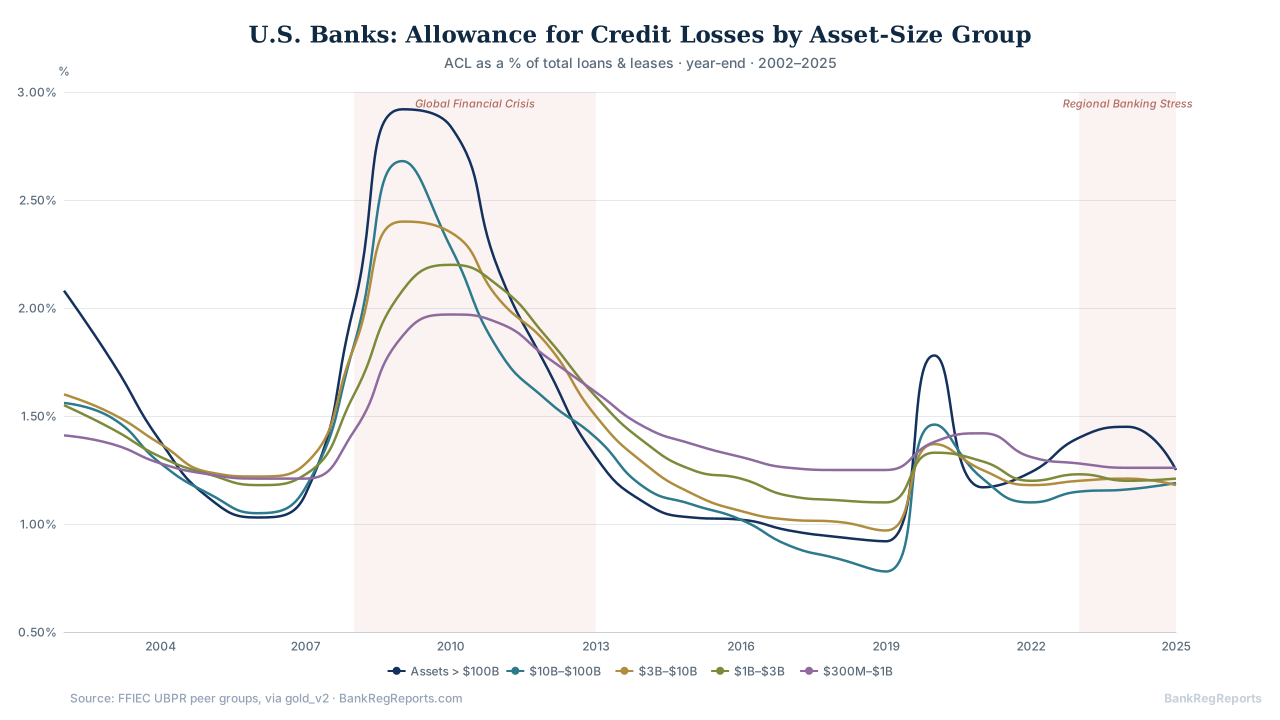
What CECL Actually Requires
CECL stands for Current Expected Credit Losses. FASB introduced it in Accounting Standards Update (ASU) 2016-13, with the model codified at ASC 326.
The requirement is direct: when a bank originates a loan, it estimates the credit losses it expects to incur over the entire contractual life of that loan and records that estimate immediately as a reserve. The estimate must incorporate historical loss experience, current conditions, and “reasonable and supportable” forecasts of future economic conditions. Not a probability-weighted worst case. An expected value, over the full term, booked on day one.
The reserve that results is the allowance for credit losses (ACL), which sits as a contra-asset against gross loans on Schedule RC of the FFIEC 031/041/051. The provision for credit losses — RIAD4230 on the call report — is the income-statement expense that funds it each period. FDIC guidance on CECL has a clean summary of the mechanics if you want the regulator’s framing.
What Replaced CECL Was Genuinely Broken
The prior model — the incurred-loss standard — required a bank to reserve for a loss only once it was probable the loss had already been incurred. In practice, that meant waiting for observable evidence of credit deterioration before booking any reserve. A performing loan with no delinquency signs carried almost no allowance, even if it was underwritten loosely at the top of a cycle.
The problem showed up clearly in 2007 and 2008. Reserve levels entering the crisis were thin. As charge-offs mounted, banks had to build allowances rapidly and simultaneously, which compressed earnings and capital precisely when they could least afford it. The pro-cyclical dynamic amplified the stress. FASB spent years on CECL partly in direct response to that failure.
The conceptual difference is worth stating plainly:
| Incurred-loss (prior) | CECL (current) | |
|---|---|---|
| When reserves are built | After losses appear | At origination, over the loan’s life |
| Forecast incorporation | None | Required — current conditions + projections |
| Cycle behavior | Reserves lag deterioration | Reserves build during good times |
| P&L sensitivity | Low in good times, spikes in stress | Higher baseline volatility, less cliff risk |
The trade-off CECL makes is more provision expense volatility in exchange for fewer surprise reserve builds in downturns. Whether individual banks execute that well depends entirely on model quality and the reasonableness of their economic assumptions — which are not disclosed in any detail in public filings.
The Accounting Mechanics: Provision, Allowance, Charge-offs
Three line items do all the work:
Provision for credit losses (RIAD4230) — the periodic income-statement charge a bank records to build or adjust the ACL. This is what hits earnings. A bank growing its portfolio aggressively in a deteriorating economy will run elevated provision expense even if no loans have gone bad yet.
Allowance for credit losses (RCON3123) — the cumulative balance-sheet reserve against expected losses. It sits as an offset to gross loans. The allowance does not reduce the contractual principal owed; it reduces the carrying value of the loan book on the bank’s books.
Net charge-offs — when a loan is deemed uncollectible, the bank writes it off against the allowance. Recoveries on previously charged-off loans flow back in. The net of these two is the net charge-off figure.
The identity is: beginning ACL + provision − net charge-offs = ending ACL. A bank can hold its ACL flat by setting provision roughly equal to net charge-offs, or it can build reserves by provisioning above charge-offs, or it can release reserves by doing the opposite — which boosts earnings but may signal that management thinks credit conditions are improving.
Reserve releases are worth watching. They are accretive to earnings but reduce the cushion. Several large banks released substantial reserves in 2021 as the pandemic credit losses they had anticipated did not materialize at the scale modeled.
When Banks Had to Adopt CECL
Adoption was phased:
- Larger SEC-filing institutions (non-smaller reporting companies) adopted for fiscal years beginning after December 15, 2019 — effectively January 1, 2020 for calendar-year banks.
- Smaller reporting companies, private banks, and other entities received an extended deadline and adopted for fiscal years beginning after December 15, 2022 — effectively January 1, 2023.
The stagger matters for peer analysis. Through 2022, you had a mix of CECL and incurred-loss reporters in the same peer group. A community bank’s ACL/loans ratio of 1.1% in mid-2022 was not directly comparable to a CECL-reporting peer at 1.5% — the methodologies were different, not the credit culture. The Federal Reserve’s CECL FAQ covers the capital transition elections that accompanied adoption.
Today, adoption is complete across the industry. All call report filers are on CECL.
How to Read Reserve Adequacy
Four measures do most of the work in an asset quality review:
ACL to total loans — the headline coverage ratio. Calculated from RCON3123 ÷ RCON2122. The industry median has historically run in the 1.0–1.5% range in calm periods and approaches 3% in severe stress. What matters more than the level is the trend relative to peers and relative to the bank’s own loan mix — a CRE-heavy portfolio should carry more reserve than a plain-vanilla residential mortgage book.
ACL to nonperforming loans — how well the allowance covers the loan book already showing distress. A ratio above 100% means reserves exceed the balance of nonperforming loans. A ratio below 100% is not automatically a problem, but it warrants understanding why — strong collateral coverage is a common legitimate explanation.
Provision to average loans (annualized) — what the bank is spending to maintain or build its reserve, relative to the size of the portfolio. Watch this alongside loan growth. If loans are growing at 15% and the provision rate is flat, the allowance is not keeping pace with the risk being added.
Net charge-off rate — the losses actually realized, which the allowance is supposed to anticipate. A bank consistently provisioning well below its realized charge-off rate is drawing down its cushion, which will eventually require a catch-up provision hit.
All of this connects directly to asset-quality frameworks like the Texas Ratio, which uses the allowance as part of the denominator’s credit-risk denominator. A bank that has systematically under-reserved can look healthier on that ratio than it actually is.
Pulling CECL Data with BankRegReports
CECL-era reserve data — allowance, provision, charge-offs, and coverage ratios — is available through BankRegReports for every U.S. bank, quarterly, back through 2000. The BankRegReports API returns UBPR-validated figures from FFIEC call report data, so you are working with the same source the examiners use.
from bankregreports import BankReg

client = BankReg("brr_your_api_key")

# Pull ACL and coverage metrics for a single bank
reserves = client.bank("1069782").metrics(
    codes=["acl_pct_loans", "acl_pct_npl", "provision_pct_avg_loans", "nco_rate"],
    start="2018-12-31",
    end="2025-12-31",
    frequency="quarterly"
)

print(reserves.head())
# rssd_id    period       acl_pct_loans  acl_pct_npl  provision_pct_avg_loans  nco_rate
# 1069782    2018-12-31   1.12           182.4        0.18                     0.09
# 1069782    2019-12-31   1.09           174.1        0.19                     0.11
# 1069782    2020-03-31   1.68           241.7        0.89                     0.14   # CECL day 1
# 1069782    2020-12-31   2.01           198.3        1.42                     0.22
# ...
The full API reference documents all available metric codes and the underlying MDRM mappings. For CECL analysis, acl_pct_loans maps to RCON3123 ÷ RCON2122; provision_pct_avg_loans maps to RIAD4230 annualized over average RCON2122.

The divergence between provision and actual charge-offs in 2020 is CECL working as designed — or at least as intended. Whether the models that generated those estimates were actually good is a separate question, and one the current data cannot fully answer.
Frequently Asked Questions
What does CECL stand for? CECL stands for Current Expected Credit Losses. It is the FASB accounting model, introduced in ASU 2016-13, under which banks estimate and reserve for the credit losses they expect over the entire life of a loan at the time it is originated.
How is CECL different from the old incurred-loss model? Under the prior incurred-loss model, a bank reserved for a loss only once it was probable the loss had already occurred. CECL is forward-looking: banks estimate expected losses over the full life of a loan up front, incorporating current conditions and reasonable forecasts, so reserves are built ahead of the credit cycle rather than after losses appear.
When did CECL take effect? Larger SEC-filing banks adopted CECL in 2020 (fiscal years beginning after December 15, 2019). Smaller reporting companies and private entities received an extended timeline and adopted it in 2023 (fiscal years beginning after December 15, 2022).
What is the allowance for credit losses (ACL)? The allowance for credit losses is the balance-sheet reserve a bank holds against expected loan losses under CECL. It is built through the provision for credit losses (an income-statement expense) and reduced by net charge-offs when loans become uncollectible.
What is the difference between the provision and the allowance? The provision for credit losses is the periodic expense a bank records to build or adjust its reserve. The allowance for credit losses is the cumulative reserve balance on the balance sheet. Provision builds the allowance; charge-offs draw it down.
Where can I find a bank’s allowance for credit losses? The allowance, provision, charge-offs, and coverage ratios are reported in the call report — Schedule RC and Schedule RI — and standardized in the UBPR. BankRegReports displays them for every U.S. bank with historical trends and peer comparisons.
The one thing worth sitting with: CECL shifted loss recognition forward, but it did not make reserve estimates more accurate. It made them more visible, more forward-looking, and more sensitive to economic assumptions that are disclosed only in broad strokes. The next credit cycle will test whether the models banks built actually anticipated what happened — and the data to answer that question will live in the call report.
The data referenced in this post is available through the BankRegReports Data API. The BankRegAPI Python SDK (pip install bankregreports) returns clean, UBPR-validated data from FFIEC, FDIC, Federal Reserve, NCUA, and SEC EDGAR in a single call. Get a free API key →