Nonperforming Loans and the NPL Ratio: What the Number Actually Tells You
At the peak of the 2008 credit cycle, the industry-wide noncurrent loan rate hit 5.4% — nearly one in twenty loan dollars had stopped performing. Community banks concentrated in residential …
At the peak of the 2008 credit cycle, the industry-wide noncurrent loan rate hit 5.4% — nearly one in twenty loan dollars had stopped performing. Community banks concentrated in residential construction cleared 10%, 15%, even 20% in the worst markets. By then, the charge-offs were inevitable. The NPL ratio had been screaming for two years before the losses showed up in the income statement.
That lag is the whole point. The nonperforming loan ratio is one of the few credit metrics that genuinely leads realized losses rather than confirming them. Here is how it works, where the data comes from, and what to do with it.
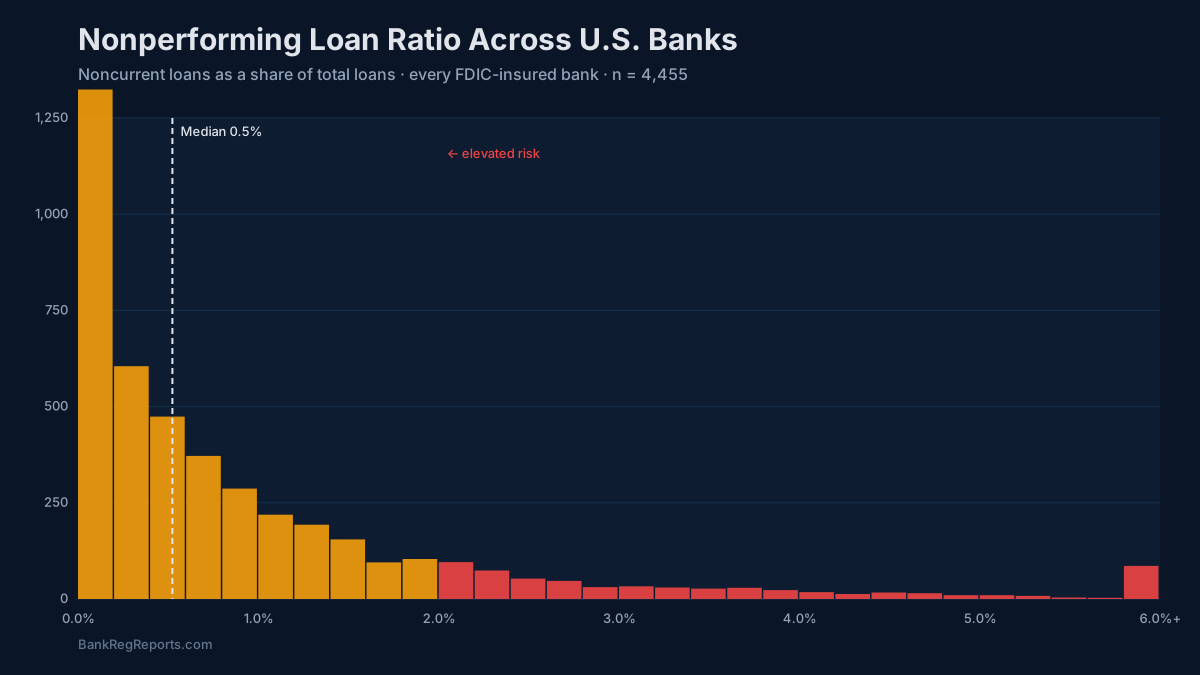
What Counts as a Nonperforming Loan
The term gets used loosely, so the regulatory definition matters. In U.S. call report reporting, “nonperforming” and “noncurrent” are effectively synonymous and cover two buckets:
Loans 90 or more days past due and still accruing interest. The bank hasn’t stopped the accrual clock yet, but the borrower is three or more payments behind. These sit in Schedule RC-N of the FFIEC 031/041/051.
Nonaccrual loans. The bank has concluded that collection is doubtful and has stopped booking interest income. Once a loan goes nonaccrual, any interest payments received typically get applied to principal first. RCON1403 (nonaccrual loans) is the line item; banks report it quarterly.
Thirty-to-89-day past-due loans are tracked separately and matter as a leading indicator to the NPL ratio itself — but they don’t count as nonperforming. Many of them cure. The 90-day threshold is where regulators, auditors, and examiners start treating the credit as a genuine problem.
When people refer to nonperforming assets rather than loans, they’re adding OREO — other real estate owned, meaning property the bank took through foreclosure. The NPL ratio stays loan-focused; NPA ratios bring in OREO. Know which one you’re looking at before drawing conclusions.
The Formula and Where the Data Lives
NPL Ratio = Noncurrent Loans ÷ Total Loans
The numerator pulls from Schedule RC-N, which breaks down past-due and nonaccrual balances by loan category — residential real estate, commercial real estate, C&I, consumer, and so on. That granularity is what makes RC-N useful. The ratio tells you that 2.1% of the book is nonperforming; the schedule breakdown tells you it’s concentrated in construction loans, which is a very different conversation than broad-based consumer deterioration.
The UBPR takes these raw call report inputs and standardizes them into the noncurrent loan ratio (UBPR Page 4, “Asset Quality”), complete with peer comparisons by asset size and loan-mix group. Most analysts cite the UBPR version because the peer context is built in.

The post-GFC decline is visible but so is the 2020 blip — which was short-lived partly because of forbearance programs that kept loans from rolling into past-due status. Worth remembering when interpreting current ratios against that era’s apparent stability.
A Concrete Example
| Component | Balance |
|---|---|
| Loans 90+ days past due, accruing (RCON1407 equivalent) | $4.2M |
| Nonaccrual loans (RCON1403) | $13.8M |
| Total noncurrent loans | $18.0M |
| Total loans (RCON2122) | $720.0M |
| NPL Ratio | 2.5% |
Two and a half percent means one in forty dollars of this bank’s loan book has stopped performing. That’s elevated for a bank with a diversified book in a benign credit environment. Whether it’s a problem depends entirely on what drove it and whether the allowance covers it.
from bankregreports import BankReg

client = BankReg("brr_your_key_here")

# Pull NPL ratio and allowance coverage for a specific bank
credit = client.bank("RSSD:112837").credit_quality(periods=8)

print(credit[["report_date", "noncurrent_loan_ratio", "allowance_to_noncurrent"]])

# report_date    noncurrent_loan_ratio    allowance_to_noncurrent
# 2024-09-30     0.0251                   1.12
# 2024-06-30     0.0198                   1.31
# 2024-03-31     0.0174                   1.47
# 2023-12-31     0.0142                   1.68
# 2023-09-30     0.0119                   1.89
# 2023-06-30     0.0103                   2.11
# 2023-03-31     0.0091                   2.34
# 2022-12-31     0.0082                   2.52
The trend here is the story. NPL ratio nearly tripling in eight quarters while coverage collapses from 2.5x to 1.1x is the pattern you want to catch early. BankRegReports surfaces this automatically across every reporting bank.
What Levels Mean What
General benchmarks for a diversified bank in a normal credit environment:
| NPL Ratio | What It Suggests |
|---|---|
| Below 1.0% | Strong asset quality; consistent with top-quartile UBPR peer |
| 1.0% – 2.0% | Normal range; manageable with adequate reserves |
| 2.0% – 3.0% | Elevated; warrants investigation by portfolio segment |
| Above 3.0% | Significant credit stress; examiner attention likely |
The caveat on all of these: loan mix dominates. A bank with 60% of its book in construction and land development should be held to a tighter standard than one in owner-occupied CRE and 1-4 family residential. The UBPR peer groups account for this partially, but the underlying mix always matters more than the peer bucket label.
Trend beats level every time. A bank moving from 0.7% to 1.9% over six quarters is in worse shape than one sitting at a stable 2.1%. The direction, the pace, and the segment driving it tell you more than the absolute figure.
Why the NPL Ratio Leads Charge-Offs
The deterioration sequence in commercial and consumer credit is fairly predictable: current → 30–89 days past due → 90-plus days or nonaccrual → charge-off. The NPL ratio captures stress at the third stage. Charge-offs confirm it at the fourth.
That gap — typically one to three quarters — is where the value is. When a bank’s NPL ratio starts moving, the analyst with that data can ask questions that matter: which loan categories are driving it, is the allowance positioned ahead of the emerging losses, is management moving credits to special mention or substandard on the internal rating system, and are they adding to reserves proactively or reactively.
By the time charge-offs appear, those questions are largely academic. The decisions that determine whether a credit problem stays manageable or becomes existential get made in that window.
The Metrics Around It
The NPL ratio doesn’t stand alone. Three connections worth keeping close:
Allowance coverage. The coverage ratio — allowance for credit losses divided by noncurrent loans — shows whether reserves are sized ahead of known problems. Coverage above 1.0x means the allowance exceeds current nonperforming balances. Coverage falling below 1.0x, especially while the NPL ratio rises, is an early signal that management may be behind the curve on reserving.
Net charge-offs. The net charge-off rate is the lagging realization of what the NPL ratio signals in advance. Watching both together shows whether a bank’s NPL pipeline is resolving through recoveries and cures or converting to actual losses.
Texas Ratio. The Texas Ratio puts nonperforming assets over tangible equity plus loan loss reserves. It’s a failure-proximity metric. The NPL ratio feeds directly into the numerator. Banks that hit a Texas Ratio above 100% historically failed at significantly elevated rates during the GFC.

Where to Find This Data
Schedule RC-N of the quarterly call report is the primary source. For FFIEC 031 filers (banks with foreign offices), the noncurrent detail is more granular than for 041/051 filers, but the key aggregates are consistent across forms. The UBPR reorganizes this into the noncurrent loan ratio with peer benchmarks built in — it’s the faster starting point for most analysis.
BankRegReports calculates the noncurrent loan ratio for every U.S. bank across more than 24 years of quarterly history, breaks it out by loan category using the Schedule RC-N detail, and overlays allowance coverage and charge-off trends in the same view. The BankRegReports Data API gives programmatic access to all of it, including peer comparisons against custom groups. Full endpoint documentation is at api.bankregreports.com/api/v1/docs/.
The one thing worth doing right now: pull the NPL ratio trend for three or four banks in the same market and the same asset tier and compare the slopes. A bank drifting upward while peers stay flat is telling you something. The absolute level is the starting point; the divergence from peers is the signal.
Frequently Asked Questions
What is a nonperforming loan? A nonperforming loan is one on which the borrower is not meeting the agreed payment schedule and full repayment is in doubt. In U.S. bank reporting it includes loans 90 or more days past due and still accruing, plus nonaccrual loans on which the bank has stopped recognizing interest income.
How is the NPL ratio calculated? Nonperforming (noncurrent) loans divided by total loans, expressed as a percentage. The inputs come from Schedule RC-N of the bank’s quarterly call report, filed on the FFIEC 031, 041, or 051 depending on bank type.
What is a good NPL ratio for a bank? Below 1% is strong. The 1%–2% range is normal for a diversified book. Above 2% warrants investigation; above 3% signals significant stress. Peer comparison and trend direction matter more than the absolute number.
What is the difference between past-due and nonaccrual loans? Past-due loans are behind on payments. Those 90 or more days past due and still accruing are counted as nonperforming. Nonaccrual loans are those on which the bank has stopped recognizing interest income because collection is doubtful. Both categories are reported in Schedule RC-N and both roll into the NPL ratio numerator.
Why is the NPL ratio a leading indicator of credit problems? Nonperforming loans appear in the deterioration sequence one to three quarters before losses are realized as charge-offs. A rising NPL ratio gives analysts time to investigate which portfolios are weakening and whether reserves are adequate — the charge-off rate only confirms what has already happened.
Where can I find a bank’s nonperforming loan ratio? Schedule RC-N of the call report and the UBPR are the primary sources. BankRegReports displays the noncurrent loan ratio for every U.S. bank with historical trends, portfolio-level detail, and peer benchmarks.
The data referenced in this post is available through the BankRegReports Data API. The BankRegAPI Python SDK (pip install bankregreports) returns clean, UBPR-validated data from FFIEC, FDIC, Federal Reserve, NCUA, and SEC EDGAR in a single call. Get a free API key →