The Largest Banks in America by Assets (2026)
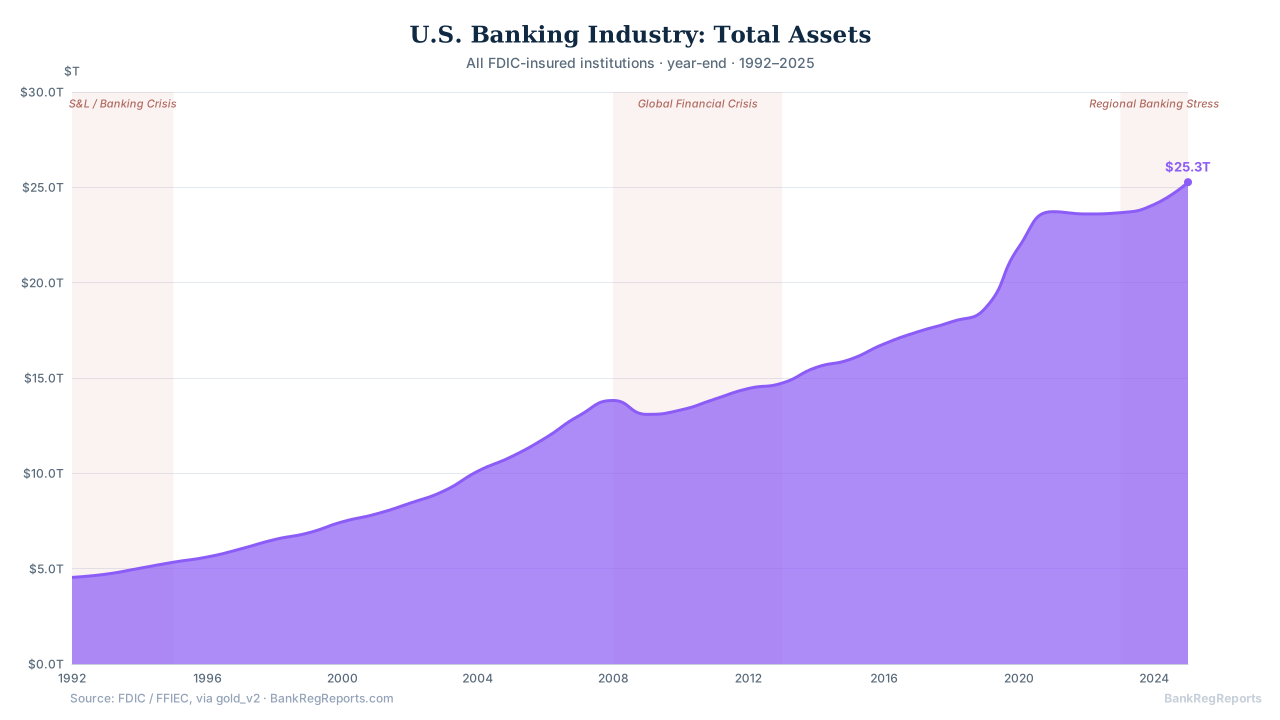
JPMorgan Chase Bank, N.A. alone holds more assets than the entire U.S. banking system did in 1995. That single figure — over $4 trillion on one balance sheet — captures …
JPMorgan Chase Bank, N.A. alone holds more assets than the entire U.S. banking system did in 1995. That single figure — over $4 trillion on one balance sheet — captures three decades of consolidation, crisis, and balance sheet expansion that transformed American banking. But the standard “largest banks in America” list, while technically accurate, tells you almost nothing about institutional health, and conflating size with safety is a mistake that regulators, investors, and occasionally boards still make.
This post ranks the largest U.S. banks by total assets, explains exactly what that figure measures, untangles the bank-versus-holding-company distinction that causes two rankings of the same institution to show different numbers, and gives you the tools to pull current data on any bank yourself.

The industry crossed $24 trillion in aggregate assets. Four institutions account for a disproportionate share of that total.
What “Total Assets” Actually Measures
Total assets is the sum of everything on the left side of a bank’s balance sheet: loans, investment securities, cash and equivalents, trading assets, premises, and other holdings. Every FDIC-insured bank reports this figure quarterly on the FFIEC 031 or FFIEC 041 call report — the 031 for banks with foreign offices, the 041 for domestic-only institutions above $100 million, and the FFIEC 051 for smaller community banks on the simplified form.
The specific line is Schedule RC, item 12 — RCON2170. One number, filed uniformly across all 4,300-plus institutions, which is what makes it the standard ranking metric.
Other measures tell different stories. Total deposits measure funding depth. Market cap reflects investor expectations about future earnings. Tier 1 capital measures loss-absorption capacity. Assets measure the raw scale of what a bank is doing with the money entrusted to it. For size rankings, assets is the right metric. For soundness assessments, you need the full set.
The Bank vs. Holding Company Problem
This is the single most common source of confusion in rankings, and it matters for compliance and supervision reasons, not just analytical tidiness.
The insured depository institution — the bank itself — files the FFIEC call report and carries an FDIC certificate number. JPMorgan Chase Bank, N.A. is the bank. Its call report reflects banking activities: loans, deposits, investment securities held at the charter level.
The bank holding company — the parent — files the FR Y-9C with the Federal Reserve and carries an RSSD ID. JPMorgan Chase & Co. is the holding company. It consolidates the bank plus broker-dealer subsidiaries, asset management entities, and other nonbank operations. Its balance sheet is larger. Sometimes substantially larger.
When two reputable sources show different asset totals for “JPMorgan,” they are measuring different legal entities. Neither is wrong. The Federal Reserve’s Large Commercial Banks release measures bank charter assets. FR Y-9C consolidates the holding company. Always confirm which basis a ranking uses before drawing cross-institution comparisons.
BankRegReports pulls call report data — bank charter level — so comparisons across the platform are on a consistent regulatory basis. If you are looking at a holding company peer group, the FR Y-9C data works the same way: consistent basis, consistent conclusions.
The Largest Banks in America by Total Assets
At the bank charter level, based on the most recent quarterly call report filings:
| Rank | Institution | Approx. Total Assets |
|---|---|---|
| 1 | JPMorgan Chase Bank, N.A. | > $4 trillion |
| 2 | Bank of America, N.A. | ~$2.5 trillion |
| 3 | Wells Fargo Bank, N.A. | ~$1.8 trillion |
| 4 | Citibank, N.A. | > $1 trillion |
(Source: Federal Reserve Large Commercial Banks release, quarterly. Figures reflect bank charter totals, not consolidated holding company.)
Below the Big Four sits a tier of large regionals and specialized institutions — U.S. Bank, PNC Bank, Truist Bank, Goldman Sachs Bank USA, Capital One, TD Bank USA — generally ranging from $200 billion to just under $1 trillion. The order in this tier shifts quarter to quarter as banks grow organically, close acquisitions, or restructure. A ranking accurate last quarter may be off two or three positions today.
That volatility is exactly why static lists go stale. The Federal Reserve updates the Large Commercial Banks release quarterly, and the FDIC Quarterly Banking Profile carries the same underlying data. Both are free and authoritative. Both require real work to use for anything beyond a one-off lookup.
How Concentrated Is U.S. Banking?
The Big Four hold a structurally dominant share of total industry assets. The precise percentage shifts each quarter, but the pattern has been stable for years: four institutions represent an outsized fraction of a $24 trillion industry that includes roughly 4,336 FDIC-insured banks as of Q4 2025.

The industry started the 1990s with nearly 14,000 FDIC-insured banks. Three decades of consolidation reduced that count to 4,336. The attrition came almost entirely from mergers, not failures. What remains is a barbell structure: a handful of trillion-dollar institutions at one end and roughly 4,000 community and regional banks at the other — all filing the same call report every quarter, all subject to the same core examination framework, and all competing for the same deposit base in their local markets.
For community banks, that concentration creates a two-sided reality. The biggest institutions set pricing floors on deposits and ceilings on loan spreads. But they also systematically exit smaller markets and mid-size commercial relationships, which is where most community banks find their competitive ground.
Size Is Not a Proxy for Safety
The 2023 failures of Silicon Valley Bank ($209 billion at failure) and Signature Bank ($110 billion) should have ended this assumption. Both were large by any historical standard. Size did not protect them. Concentrated, uninsured deposit bases — SVB’s depositor base was approximately 94% uninsured — combined with large unrealized losses in held-to-maturity securities portfolios did. When confidence broke, the funding model broke with it in roughly 48 hours.
A bank’s resilience lives in its capital structure, asset quality, and funding stability. The metrics that matter to examiners — and should matter to boards — are:
Capital:CET1 ratio. Community bank median sits around 13%, well above the 6.5% well-capitalized minimum. Strong institutions run 12–14%. Anything approaching 8–9% warrants attention, particularly with rate risk or credit deterioration in the mix.
Asset quality: Nonperforming loan ratio typically runs 0.8–1.0% at healthy community banks. Above 2.0%, examiners are asking detailed questions. Net charge-offs in the 0.35–0.50% range are within historical norms; anything above 0.75% on a sustained basis is elevated. Both are on Schedule RI-B of the call report.
Profitability: Return on assets of 0.95–1.10% is typical for community banks; above 1.20% is strong; below 0.80% indicates something structural. Efficiency ratios below 60% are excellent; above 70%, the board needs a conversation about expense discipline or revenue strategy.
Funding: Loan-to-deposit ratios in the 70–80% range are typical. The SVB lesson was about deposit concentration and uninsured deposit percentage — metrics that didn’t show up in asset size rankings but were visible in the call report for years before the failure.
A $500 million community bank running 13% CET1, 0.6% NPL, 1.05% ROA, and a well-diversified deposit base is a sounder institution than a $50 billion bank carrying concentrated credit or liquidity risk. The size ranking does not tell you which is which. The call report data does.
You can pull all of those metrics for any FDIC-insured bank through BankRegReports, with 24 years of quarterly history and peer benchmarks built in.
Pulling Bank Size Data Programmatically
If you are building a peer model, screening institutions for acquisition, or tracking a specific bank over time, the BankRegReports Data API gives you call report metrics — including RCON2170 total assets — for every FDIC-insured bank, updated each quarter as new filings are published.
from bankregreports import BankReg

brr = BankReg("brr_your_api_key")

# Total assets + key health metrics for JPMorgan Chase Bank NA (RSSD 852218)
metrics = brr.bank_metrics(
    rssd_id=852218,
    metrics=["total_assets", "cet1_ratio", "npa_ratio", "roa"],
    quarters=8
)
print(metrics)

# Screen top 50 banks by asset size, current quarter
top50 = brr.bank_screener(
    min_assets=100_000_000_000,
    sort_by="total_assets",
    limit=50
)
The full endpoint reference is at api.bankregreports.com/api/v1/docs/. Every metric maps to a specific MDRM code and call report schedule — RCON2170 for total assets, RIAD4107 for net charge-offs, RCOA7205 for CET1 — so you can trace any figure back to its regulatory source.
How to Look Up Any Bank
Total assets and every other call report metric are public data. The FDIC’s BankFind Suite and the Federal Reserve’s National Information Center both publish bank-level data at no cost. They are authoritative. They are also genuinely difficult to use for anything beyond a single one-off lookup — the query interfaces are slow, bulk downloads require parsing multi-hundred-column CSVs, and assembling a multi-quarter trend for a peer group takes hours.
BankRegReports indexes the same call report data — searchable by bank name, city, state, FDIC certificate, or RSSD ID — and surfaces total assets alongside capital ratios, asset quality, profitability, and funding metrics, charted across 24 years of history with peer comparisons. The point is not to replace the primary sources; it is to make them fast and analytically useful.
One check worth making before relying on any size ranking: confirm which legal entity is being measured and which quarter the data reflects. A stale holding-company figure and a current bank-charter figure are not comparable, even when they carry the same institution name.
Frequently Asked Questions
What is the largest bank in America? By total assets at the bank charter level, JPMorgan Chase Bank, N.A. holds that position with over $4 trillion in assets. Bank of America, Wells Fargo, and Citibank follow, forming what analysts call the Big Four.
How is bank size measured? Total assets — the sum of loans, investment securities, cash, and other holdings — is the standard measure. Reported quarterly on Schedule RC of the call report (FFIEC 031/041/051), line item RCON2170.
Why do different lists show different sizes for the same bank? They are measuring different legal entities. The insured bank (call report, FDIC certificate) and its parent holding company (FR Y-9C, RSSD ID) report different asset totals. The holding company consolidates nonbank subsidiaries and is usually larger. Always check which basis a ranking uses.
How many banks are there in the United States? As of the FDIC’s Q4 2025 Quarterly Banking Profile, 4,336 FDIC-insured institutions were operating — down from nearly 14,000 in the early 1990s, a decline driven almost entirely by mergers.
Does being a large bank mean it is safer? No. SVB ($209 billion in assets) and Signature Bank ($110 billion) were both large by historical standards when they failed in 2023. Safety is a function of capital ratios, asset quality, and funding stability — not balance sheet size.
Where can I find total assets for a specific bank? The FDIC’s BankFind Suite and the Federal Reserve’s National Information Center publish call report data publicly. BankRegReports makes that data searchable and comparable for any of the 4,300-plus FDIC-insured institutions, with historical trends and peer benchmarks included.
The data in this post is available through the BankRegReports platform. Pull peer benchmarks, Call Report metrics, UBPR trends, and enforcement history for any FDIC-insured bank — no data engineering required. Explore the platform →