ROA vs. ROE for Banks: Profitability Ratios Explained
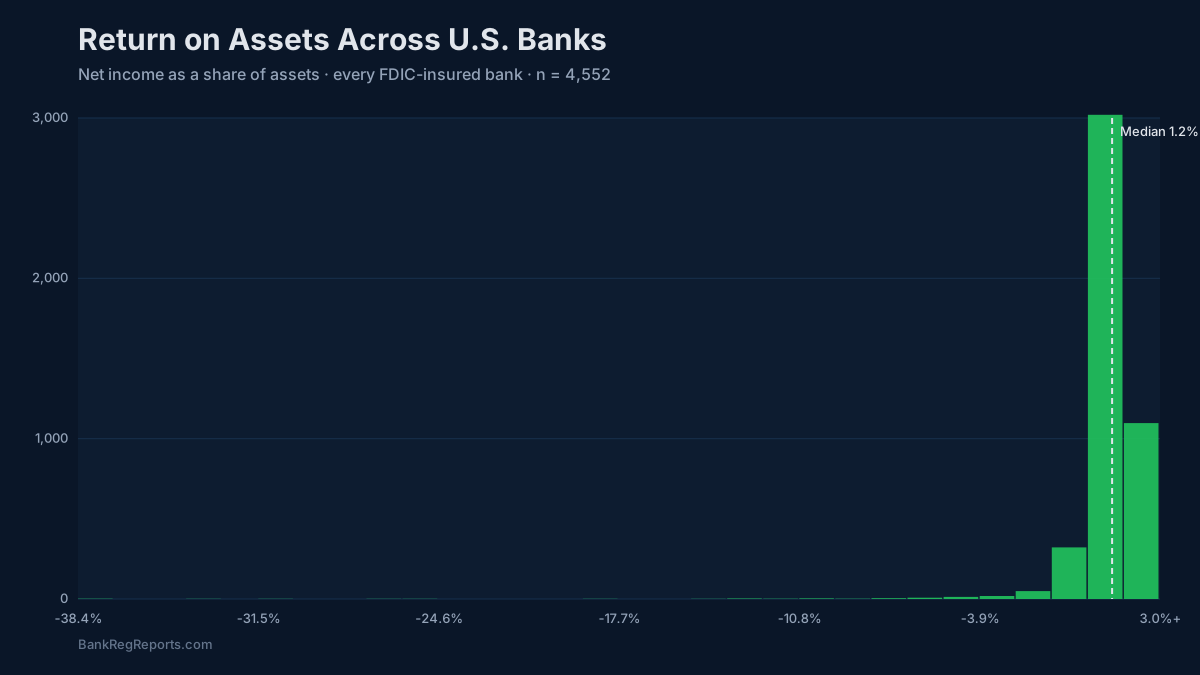
The FDIC reported an aggregate industry ROA of 1.24% for Q4 2025. In that same quarter, dozens of community banks posted ROE well above 15% — and a handful of …
The FDIC reported an aggregate industry ROA of 1.24% for Q4 2025. In that same quarter, dozens of community banks posted ROE well above 15% — and a handful of those had ROA under 0.80%. That gap is not operational excellence. It is leverage doing the heavy lifting, and it is exactly the structure that gets a bank in trouble when credit costs spike or regulators press on capital.
Return on assets and return on equity are the two headline profitability measures for any bank. They anchor every ALCO presentation and appear at the top of every UBPR. The arithmetic connecting them is simple. What that arithmetic reveals about a bank’s risk posture is not.

The chart above covers a full credit cycle. The 2009 trough is the useful teaching moment: ROAA went slightly negative while ROAE collapsed far more sharply, because the leverage that amplified returns on the way up did exactly the same on the way down.
What Return on Assets Actually Measures
Return on assets answers a direct question: for every dollar of assets on the balance sheet, how much net income does the bank produce?
ROAA = Net Income ÷ Average Total Assets
Analysts use ROAA — return on average assets — rather than a point-in-time denominator because quarter-end balances can be moved by temporary borrowings or payoffs. The FFIEC UBPR standardizes this calculation. On the call report, net income is RIAD4340 (Schedule RI) and total assets are RCON2170 (Schedule RC). The UBPR averages the asset base across reporting periods and puts ROAA on page one.
Because leverage does not enter this calculation, ROAA is the cleanest basis for comparing banks with different capital structures. A $500 million community bank running 10% equity-to-assets and a $5 billion regional running 8% can be compared on ROAA without any adjustment. That is not true of ROE.
Examiner expectations roughly follow these bands:
| ROAA | Signal |
|---|---|
| Below 0.75% | Weak — warrants closer look at margins, expenses, and credit |
| 0.95%–1.10% | Solid — typical community bank range |
| 1.20%–1.50%+ | Strong — top-quartile performance |
Sustained ROAA below 0.75% will show up as a concern in a Safety and Soundness exam, particularly if the bank is also dealing with margin pressure or rising classified assets. It is not automatically a problem — a bank in the middle of an aggressive expansion may post temporarily depressed ROAA — but examiners want to understand the path back.
What Return on Equity Actually Measures
Return on equity measures net income relative to the capital shareholders have at risk.
ROAE = Net Income ÷ Average Shareholders’ Equity
Equity is RCON3210 on Schedule RC. Like ROAA, the UBPR averages the equity base. ROAE is what board members and investors watch most closely, because it answers the question they actually care about: what return is the bank generating on their capital?
Sustained ROAE in the 10–13% range is healthy for most community banks. Below 8%, the bank may not be earning its cost of capital — and a bank that cannot clear that bar over time will eventually face pressure on its stock price or its ability to raise capital when it needs to. The 10–13% range also matters for retained earnings: a bank growing its loan book at 8–10% annually needs roughly equivalent ROE just to maintain capital ratios without dilutive equity offerings.
The Leverage Bridge
Here is the arithmetic that connects the two ratios:
ROAE = ROAA × (Average Assets ÷ Average Equity)
That multiplier — assets divided by equity — is the equity multiplier. A bank holding $12 of assets per dollar of equity (roughly 8.3% equity-to-assets) carries a multiplier of 12. One holding $15 of assets per dollar of equity carries 15.
Run two hypothetical banks through this:
- Bank A earns 1.40% ROAA with an 11x equity multiplier → 15.4% ROAE
- Bank B earns 0.85% ROAA with an 18x equity multiplier → 15.3% ROAE
From the headline ROE, they look identical. From the ROAA, they are not the same institution at all.
Now stress-test both. If credit costs rise enough to push ROAA down by 100 basis points, Bank A’s ROAE drops to 4.4%. Bank B’s goes to 7.2%. Neither is good, but Bank B ran most of the way to that outcome before the downturn even started. This is the same reason capital ratios belong alongside profitability ratios in any serious peer analysis. Leverage that boosts ROE in normal times is the same leverage that creates adequacy problems when examiners return.

What Moves These Numbers
Net income is the numerator in both ratios, so anything that moves earnings moves ROAA and ROAE. For most community banks, the drivers rank roughly as follows.
Net interest margin is almost always the dominant factor. Community bank NIM averaged approximately 3.3–3.5% in Q1 2025, down from a post-rate-hike peak near 3.8% in mid-2023. When margin compresses 20–30 basis points, everything else has to work harder to hold ROAA flat. The NIM component shows up in Schedule RI as RIAD4107 (total interest income) less RIAD4073 (total interest expense).
Noninterest income matters more at some institutions than others. Fee-dependent business models — mortgage banking, wealth management, treasury services — can generate meaningful ROAA without proportional balance sheet growth. The efficiency ratio tells you how much of that revenue is consumed by overhead before it becomes earnings. Community banks typically run efficiency ratios in the 60–65% range; below 60% is excellent, above 70% is a problem that compounds over time.
Credit costs are the wildcard. A provision spike of 40 basis points of average assets wipes out roughly 30–40% of typical community bank earnings in a quarter. Banks that report strong ROAA across a full cycle — including the down years — are demonstrating something durable. Banks that look strong only in benign credit environments are not.
For context on where credit quality stands heading into 2025: the median NPL ratio for community banks runs around 0.8–1.0%, net charge-offs are approximately 0.35–0.50% of average loans, and post-CECL allowance-to-loan ratios generally land between 1.1–1.4%. A bank with NCOs running consistently above 0.60–0.70% will have difficulty sustaining ROAA above 1.0% without offsetting margin or fee advantages.
Peer Comparisons vs. Industry Averages
The FDIC’s Q4 2025 aggregate ROAA of 1.24% is a useful reference point. Comparing your $400 million ag-focused community bank in Iowa against that number is not. The relevant comparison is a peer group of similarly sized institutions in similar markets.
This is exactly why the UBPR was built the way it was — every ratio comes with a peer distribution, not a single bank figure. The question is not “are we above 1.0% ROAA?” It is “where do we sit in the peer distribution, and has that position been improving or eroding over eight quarters?”
One other point worth stating plainly: a single strong quarter tells you very little. A bank that sold its headquarters building, recognized a gain on securities, or released loan loss reserves can post exceptional profitability metrics for one period. The trend across six to eight quarters is where the actual story lives.
Pulling the Data
BankRegReports surfaces ROAA and ROAE for every FDIC-insured institution going back to 1992, with peer comparisons drawn from UBPR data. The BankRegAPI returns these metrics directly from the underlying FFIEC 041 and FFIEC 031 call report filings.
from bankregreports import BankReg

client = BankReg("brr_your_key_here")

# Pull ROAA, ROAE, and equity multiplier — eight quarters of trend
prof = client.bank("bank_profitability", rssd_id=123456, periods=8)
print(prof.to_frame())
The equity multiplier column is the one most analysts skip. It should be the first thing you check when a bank’s ROE looks impressive. Full endpoint documentation is at api.bankregreports.com/api/v1/docs/.
Frequently Asked Questions
What is a good ROA for a community bank? Around 0.95–1.10% ROAA is solid for most community banks; 1.20% or higher is top-quartile. The FDIC reported 1.24% for the industry in Q4 2025. Below 0.75% warrants a harder look at margin, expenses, and credit quality — and will draw examiner attention in a Safety and Soundness review.
What is a good ROE for a community bank? The 10–13% ROAE range is healthy. Sustained performance below 8% raises questions about whether the bank is earning its cost of capital. Always read ROE alongside ROA — a high ROE built on leverage rather than profitability is a fundamentally different institution than one earning the same return from a strong asset base.
Why do analysts use ROAA and ROAE instead of ROA and ROE? Quarter-end balance sheet figures can be distorted by temporary transactions — short-term borrowings drawn down at period end, or large payoffs that happen to close before the report date. Averaging the asset or equity base over the period produces a more stable denominator. The UBPR defaults to averaged versions for this reason, and most bank analysts follow the same convention.
Can a bank have high ROE and still be risky? Yes, and it happens regularly. A bank running an 18x equity multiplier generates 15.3% ROAE on 0.85% ROAA. If a credit event pushes that ROAA to 0.30%, the same bank shows 5.4% ROAE and may face regulatory pressure on its capital ratios. The ROE looked reasonable right up until it didn’t. The equity multiplier is the variable that determines how fast the descent happens.
Where do I find a bank’s ROA and ROE? Both are derived from the quarterly call report and published in the UBPR. BankRegReports displays ROAA and ROAE for every U.S. bank with eight-plus quarters of trend data and peer group distributions, so you can see where a bank stands relative to its actual competition rather than the industry as a whole.
The data in this post is available through the BankRegReports platform. Pull peer benchmarks, Call Report metrics, UBPR trends, and enforcement history for any FDIC-insured bank — no data engineering required. Explore the platform →