What Is the Bank Efficiency Ratio? Formula, Benchmarks, and What Moves It
In 2023, the median efficiency ratio for U.S. community banks crossed 65% for the first time in a decade — not because banks got worse at managing costs, but because …
In 2023, the median efficiency ratio for U.S. community banks crossed 65% for the first time in a decade — not because banks got worse at managing costs, but because net interest income stopped growing fast enough to absorb the overhead they had already committed to. Two banks can run essentially identical expense bases and end up with efficiency ratios 10 points apart purely because one caught a better rate cycle. That asymmetry is the first thing to understand about this metric.
The bank efficiency ratio measures how much a bank spends in noninterest expense to generate each dollar of revenue. Lower is better — the opposite of most performance measures, and the inversion trips people up constantly.

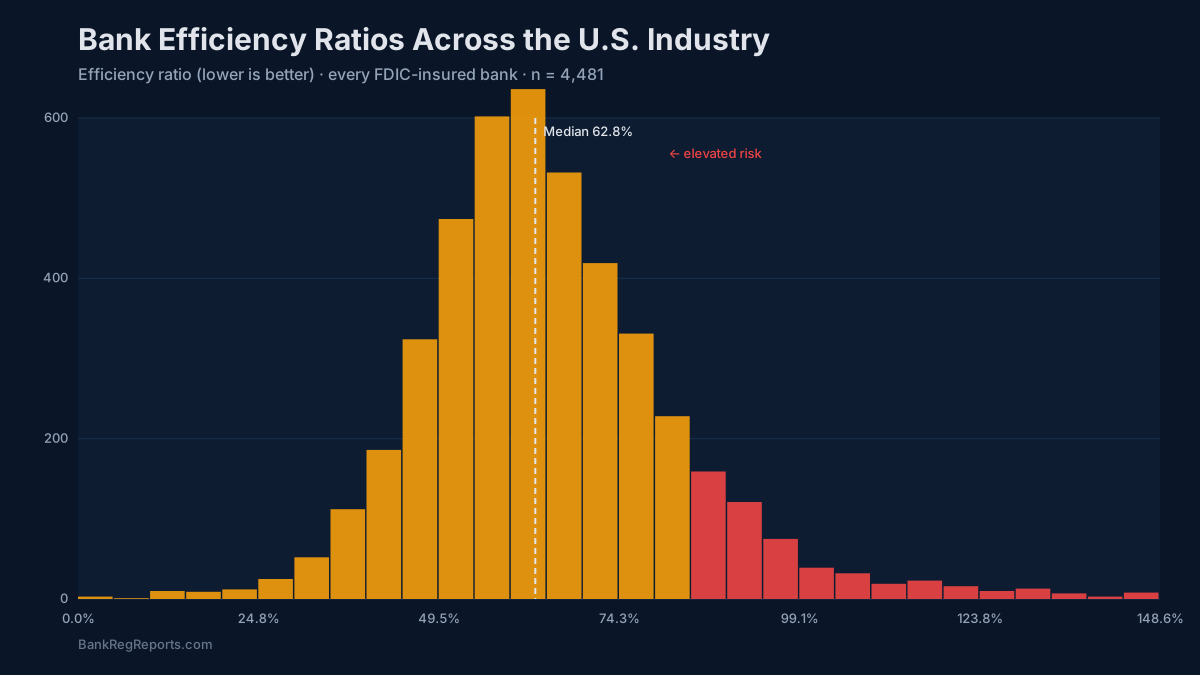
The chart makes one thing clear that aggregate headlines miss: community banks have structurally higher efficiency ratios than large banks, and the gap widens when fixed costs collide with a compressed revenue base. That is not a management failure; it is arithmetic.
The Efficiency Ratio Formula and Where the Inputs Come From
Efficiency Ratio = Noninterest Expense ÷ (Net Interest Income + Noninterest Income)
All three numbers come from Schedule RI of the FFIEC 031/041/051 call report, filed quarterly.
- Noninterest expense is RIAD4093 — the single-line total of salaries and benefits (RIAD4135), occupancy (RIAD4217), equipment (RIAD4216), and other overhead. It deliberately excludes interest expense and the provision for credit losses.
- Net interest income is RIAD4074 — interest income minus interest expense, the same figure that drives net interest margin.
- Noninterest income is RIAD4079 — service charges, interchange, wealth management fees, mortgage banking income, and similar fee revenue.
The UBPR presents the ratio in standardized, peer-adjusted form on the summary page, which is why most analysts start there rather than computing it themselves from raw Schedule RI lines. But knowing which MDRM codes feed it matters when you are building a model or trying to reconcile why a bank’s reported figure does not match yours.
One definitional wrinkle: some analysts exclude net securities gains and losses from the denominator, on the grounds that they are non-recurring. Others strip amortization of intangibles from the numerator. S&P Global does it one way; your Bloomberg terminal may do it another. Always confirm the definition when comparing across sources. The UBPR version is the most widely accepted standard for bank-to-bank comparison.
A Worked Example
A community bank with $650M in assets files its Q4 call report:
| Item | MDRM | Amount |
|---|---|---|
| Net interest income | RIAD4074 | $34.2M |
| Noninterest income | RIAD4079 | $8.7M |
| Total revenue | $42.9M | |
| Noninterest expense | RIAD4093 | $26.4M |
Efficiency Ratio = $26.4M ÷ $42.9M = 61.5%
Solid. For a sub-$1B bank running a traditional deposit-funded lending model, that is a well-managed result. If it were 71.5%, you would want to know why — is NII compressing, or did expense growth outrun revenue?
What the Benchmarks Actually Mean
The 60–65% range is typical for well-run community and regional banks. Below 60% is excellent. Above 70% draws attention; above 75%, expect exam commentary.
| Efficiency ratio | What it signals |
|---|---|
| Below 55% | Excellent; large-bank territory or an unusually fee-heavy model |
| 55%–65% | Healthy; typical of well-managed community and regional banks |
| 65%–75% | Elevated; direction of travel matters more than the point-in-time reading |
| Above 75% | Problematic; overhead is consuming too much revenue |
The 75% threshold matters in practice because examiners pay attention to it. A bank running above 75% consistently will draw ALCO scrutiny and, eventually, exam commentary. It does not trigger supervisory action by itself, but it invites pointed questions about the expense base and revenue growth trajectory.
Larger banks operate lower on this scale because they distribute fixed costs — core system licensing, BSA/AML compliance infrastructure, audit and legal overhead — across a much larger revenue base. A $200M bank and a $20B bank may pay similar base rates for regulatory technology, but the $20B bank divides that cost across 100 times the revenue. A community bank at 65% may be running tighter than a money-center bank at 58%, once you account for that fixed-cost structure.

The distribution has a long right tail. Several hundred banks routinely operate above 80% — some by design (de novos burning through startup costs), some under genuine stress. A single quarter above 80% is less informative than three consecutive quarters trending upward.
What Actually Moves the Efficiency Ratio
Because it is a ratio, it responds to pressure on either side.
Revenue compression is the sneaky driver. When the yield curve flattens or inverts, NII shrinks even if loan volume holds steady. A bank that added $5M in overhead during the rate expansion now looks worse on efficiency not because it became undisciplined, but because the revenue base contracted. This is exactly what pushed community bank efficiency ratios up in 2023: costs were sticky, NII compressed as asset repricing slowed, and the ratio moved against banks that had done nothing wrong. Blaming management without understanding the rate environment misreads the data.
Expense growth has subcategories that matter differently. Salary growth from merit increases is different from salary growth from branch expansion. Technology spend that digitizes manual processes should eventually compress other line items. When noninterest expense (RIAD4093) rises, the next question is which sub-component — break it into RIAD4135 (salaries), RIAD4217 (occupancy), RIAD4216 (equipment), and the residual. If occupancy is climbing, that is a capacity decision. If salaries are climbing faster than revenue, that is a productivity problem.
Merger accounting creates temporary distortion. Integration charges hit noninterest expense immediately. Revenue synergies materialize over 12–24 months. The efficiency ratio almost always deteriorates in the first two post-merger quarters and improves thereafter — if the deal thesis was sound. Analysts who penalize a bank’s efficiency ratio in the integration quarter without accounting for the deal context make a category error.
One-time items cut both ways. A large securities gain inflates the denominator and artificially improves the ratio. A restructuring charge hits the numerator and artificially worsens it. Neither reflects steady-state operating efficiency, which is why trend analysis over 6–8 quarters beats any single data point. When you see a bank’s efficiency ratio improve 5 points in one quarter, the first question is whether gains activity drove it.
Reading It Alongside the Right Metrics
The bank efficiency ratio tells you about overhead discipline relative to revenue. It says nothing about credit quality. A bank can post a 55% efficiency ratio while building a loan portfolio that will produce $30M in charge-offs two years from now — none of which shows up in this number until the provision hits Schedule RI.
Pair the efficiency ratio with:
- Net interest margin (~3.3–3.5% for community banks in Q1 2025, down from the ~3.8% peak in mid-2023) — to understand the revenue-side context that is driving or dampening the ratio
- Return on assets (~0.95–1.10% typical; strong above 1.20%, weak below 0.80%) — to see whether operational efficiency is converting into bottom-line profit
- Nonperforming loan ratio (~0.8–1.0% typical; above 2.0% draws heightened examiner attention) — to calibrate the credit risk not captured in the efficiency ratio
- Net charge-off rate (~0.35–0.50% typical) — same reason; a clean efficiency ratio paired with rising NCOs is a warning sign, not a clean bill of health
The UBPR summary page presents all of these in a single view with peer-group benchmarks, which is exactly why the UBPR is the right starting point for analysis rather than raw call report output. BankRegReports surfaces the same data for every FDIC-insured institution with 24+ years of quarterly history and configurable peer groups — without requiring a data engineering team to maintain the feeds.
Pulling Efficiency Ratio Data Programmatically
Analysts building peer screens or time-series models can pull efficiency ratio history alongside the underlying Schedule RI components through the BankRegReports Data API:
from bankregreports import BankReg

client = BankReg("brr_your_api_key")
result = client.bank_metrics(
    rssd_id=57031,
    metrics=["efficiency_ratio", "noninterest_expense", "net_interest_income", "noninterest_income"],
    start_quarter="2022Q1",
    end_quarter="2025Q4"
)
print(result.tail(4).to_string())
Metric values map directly to MDRM codes — RIAD4093, RIAD4074, RIAD4079 — so you can verify against the source filing. Full endpoint documentation is at api.bankregreports.com/api/v1/docs/.
Frequently Asked Questions
What is a good efficiency ratio for a community bank? Most well-managed community banks operate in the 55%–65% range. Below 60% is excellent. Above 70% warrants a closer look at which revenue or expense line is responsible. Peer-group comparison within the same asset tier is more meaningful than any absolute threshold — a $300M bank and a $3B bank have fundamentally different cost structures.
How is the bank efficiency ratio calculated? Noninterest expense (RIAD4093) divided by the sum of net interest income (RIAD4074) and noninterest income (RIAD4079), expressed as a percentage. Some analysts adjust for securities gains or intangible amortization; confirm the definition before comparing across sources or platforms.
Why is a lower efficiency ratio better? It is a cost-to-revenue measure, not a yield measure. A lower percentage means less overhead consumed per dollar of revenue generated. Most profitability ratios reward higher values; this one rewards lower.
Does the efficiency ratio include credit losses? No. The provision for credit losses is excluded from both the numerator and denominator. That exclusion isolates operating efficiency from credit cycle effects. It also means a bank can look efficient while building up credit problems that have not yet hit the income statement — which is why you should never read it in isolation.
Why do large banks usually have lower efficiency ratios? Fixed costs — core systems, compliance functions, legal and audit infrastructure — do not scale linearly with assets. A $500B bank pays more in absolute terms than a $500M bank, but far less as a percentage of the revenue base. The efficiency ratio advantage at scale is real and structural.
Where can I find a bank’s efficiency ratio? Schedule RI of the call report contains the raw inputs; the UBPR presents the computed, peer-adjusted ratio. BankRegReports displays it for every U.S. bank with full quarterly history and peer benchmarking built in — and flags when a ratio is moving in a direction worth watching.
One thing worth sitting with: efficiency ratio improvement is not inherently good, and deterioration is not inherently bad. A bank that cuts technology investment, reduces training, and freezes hiring will show a clean efficiency ratio right up until it starts losing deposits to a competitor whose platform actually works. The ratio rewards cost restraint; it does not distinguish between restraint and underinvestment. That judgment call belongs to the people running the institution — the number just tells you where to start asking questions.
The data in this post is available through the BankRegReports platform. Pull peer benchmarks, Call Report metrics, UBPR trends, and enforcement history for any FDIC-insured bank — no data engineering required. Explore the platform →