What Is Net Interest Margin? A Bank Profitability Guide
Net interest margin is the single most important measure of a bank's core profitability — the spread it earns between lending out money and paying for funding. Learn what NIM …
If you had to judge a bank’s health with a single profitability number, net interest margin would be the one to choose. It captures the essence of what a traditional bank does: borrow money cheaply through deposits and lend it out at a higher rate. The gap between those two — scaled to the assets that actually earn interest — is the net interest margin, and it drives the overwhelming majority of most banks’ earnings.
This guide explains what net interest margin is, how it is calculated, what a healthy level looks like, and what causes it to expand or compress.
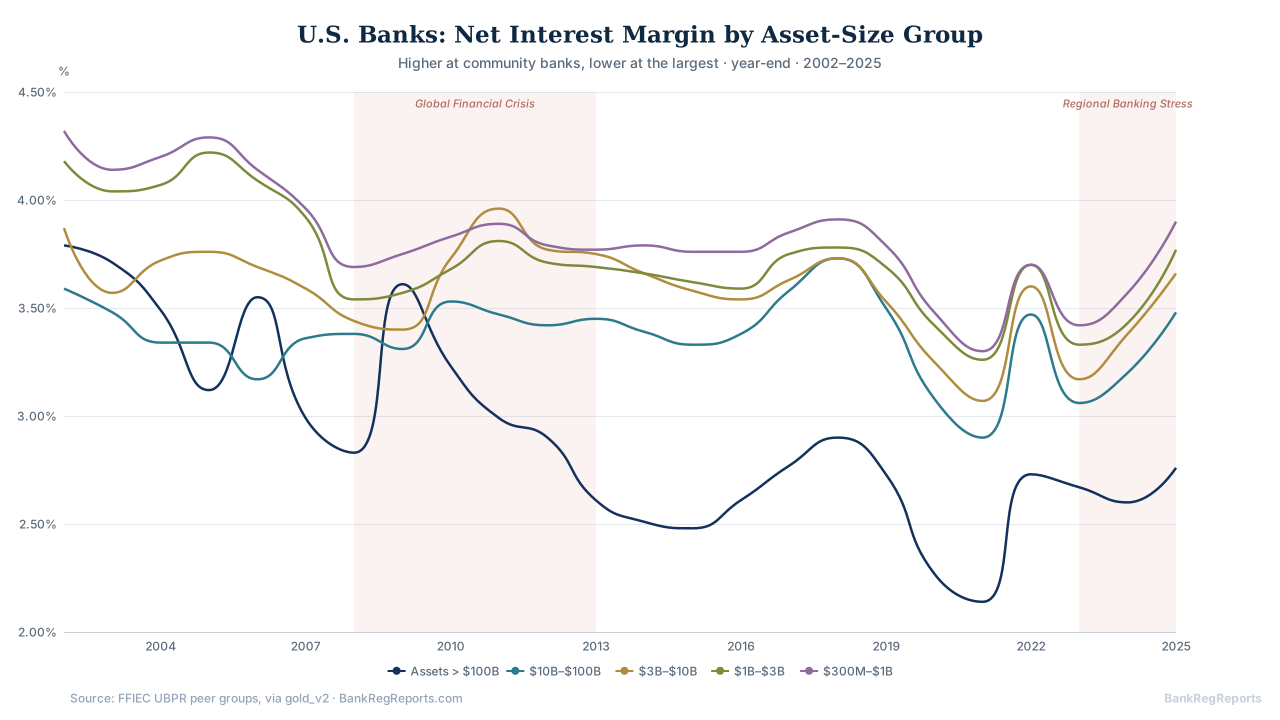
What Is Net Interest Margin?
Net interest margin (NIM) measures how much net interest income a bank generates relative to its interest-earning assets. In plain terms, it answers: for every dollar of loans and securities the bank holds, how much net interest profit does it earn?
A bank earns interest income on its loans and investment securities. It pays interest expense on its deposits and borrowings. The difference is net interest income. Divide that by the bank’s average earning assets, and you have the net interest margin — expressed as a percentage.
Because nearly every traditional bank lives or dies on this spread, NIM is the first profitability metric most analysts examine. A bank can have impressive fee income and tight expense control, but if its core lending spread is eroding, the franchise is under pressure.
The Net Interest Margin Formula
Net Interest Margin = Net Interest Income ÷ Average Earning Assets
Where:
- Net interest income = total interest income − total interest expense
- Average earning assets = the average balance of assets that generate interest (loans, leases, investment securities, interest-bearing balances at other banks, and federal funds sold)
Note that the denominator is earning assets, not total assets. Non-earning assets — the bank premises, goodwill, cash in the vault — are excluded because they do not generate interest income. Using earning assets isolates the productivity of the bank’s actual lending and investing activity.
A Worked Example
Consider a community bank over one year:
| Item | Amount |
|---|---|
| Total interest income | $48 million |
| Total interest expense | $14 million |
| Net interest income | $34 million |
| Average earning assets | $920 million |
Net Interest Margin = $34 million ÷ $920 million = 3.70%
A NIM of 3.70% means the bank earns about 3.7 cents of net interest profit on every dollar of earning assets it holds, before accounting for credit losses, overhead, and fee income.
What Is a Good Net Interest Margin?
There is no universal “correct” NIM — it varies by business model, asset mix, and the interest-rate environment. That said, broad reference points help:
| NIM range | General interpretation |
|---|---|
| Below 2.5% | Thin; often a sign of funding pressure or a low-yield asset mix |
| 3.0% – 4.0% | Typical, healthy range for many community banks |
| Above 4.0% | Strong; common at banks with higher-yielding loan books |
A few caveats matter. A high NIM is not automatically good — it can reflect a riskier, higher-yielding loan portfolio that may produce larger losses later. A lower NIM is not automatically bad — a bank concentrated in low-risk, low-yield assets accepts a thinner spread in exchange for safety. As always, the most useful read comes from comparing a bank against its peer group rather than an absolute benchmark, and from tracking the trend over several quarters.
What Makes Net Interest Margin Rise or Fall?
NIM is squeezed or stretched by a handful of forces:
Interest-rate environment. When rates rise, banks can charge more on new and floating-rate loans — but they also face pressure to pay more on deposits. Whether NIM expands or compresses depends on which side reprices faster, which is a function of the bank’s asset and liability structure.
Asset mix. A bank shifting from low-yield securities into higher-yield commercial loans will generally see NIM rise (along with credit risk). A bank parking funds in cash and Treasuries will see NIM fall.
Funding mix and cost of funds. A bank funded by low-cost core deposits enjoys a structurally higher NIM than one leaning on brokered deposits or wholesale borrowings. This is one reason deposit quality and NIM are analyzed together.
Competition. In a competitive lending market, banks may shave loan rates to win business, compressing the spread.
Deposit beta. This measures how much of a rate increase a bank must pass through to depositors. A low deposit beta — depositors who don’t demand higher rates — protects NIM as rates rise.
NIM vs. Other Profitability Measures
NIM is powerful but partial. It says nothing about fee income, overhead, or credit losses. To see the full profitability picture, pair it with:
- Return on assets (ROA) — overall profit relative to total assets, capturing fees and expenses, not just spread.
- Efficiency ratio — how much the bank spends to generate each dollar of revenue.
- Net charge-off rate — the credit losses that ultimately eat into the margin NIM measures.
A bank with a strong NIM but a bloated efficiency ratio may still be barely profitable. The metrics are complements, not substitutes, which is why the UBPR presents them together on its summary page.
How to Find a Bank’s Net Interest Margin
Net interest income comes directly from Schedule RI (the income statement) of the quarterly call report, and average earning assets are derived from the balance sheet schedules. The UBPR computes NIM in standardized form and places it alongside peer comparisons.
BankRegReports calculates net interest margin for every U.S. bank, charts it across more than 24 years of quarterly history, and benchmarks it against custom peer groups — so you can see not just the current spread but whether it is expanding or compressing relative to comparable institutions. For an asset-liability committee, a board member, or an analyst, that trend view is where the real insight lives.
Start for free — no credit card required →
Frequently Asked Questions
What is a good net interest margin for a bank? There is no universal target, but many healthy community banks operate in the 3.0%–4.0% range. A NIM below 2.5% often signals funding pressure or a low-yield asset mix, while a NIM above 4.0% is strong but may reflect a higher-risk loan book. Comparing against a peer group is more meaningful than any absolute benchmark.
How is net interest margin calculated? Net interest margin equals net interest income (total interest income minus total interest expense) divided by average earning assets. The result is expressed as a percentage. Earning assets include loans, leases, investment securities, and interest-bearing balances, but exclude non-earning assets like premises and goodwill.
What is the difference between net interest income and net interest margin? Net interest income is a dollar amount — interest earned minus interest paid. Net interest margin is that figure expressed as a percentage of average earning assets, which makes it comparable across banks of different sizes.
Why does net interest margin change when interest rates move? When rates change, a bank’s assets and liabilities reprice at different speeds. If loan yields rise faster than deposit costs, NIM expands; if deposit costs rise faster, NIM compresses. The outcome depends on the bank’s specific asset-liability structure and its deposit beta.
Is a higher net interest margin always better? Not necessarily. A high NIM can reflect a higher-yielding, higher-risk loan portfolio that may generate larger credit losses later. A lower NIM may reflect a deliberately conservative, low-risk asset mix. NIM should be read alongside credit-quality and capital metrics.
Where can I find a bank’s net interest margin? NIM is derived from the call report and standardized in the UBPR. BankRegReports displays it for every U.S. bank with historical trends and peer comparisons.