Brokered & Uninsured Deposits: A Bank Risk Guide
Not all deposits are equally reliable. Brokered and uninsured deposits can flee a bank in days, as 2023 made painfully clear. Learn what these deposit types are, why they signal …
For most of banking’s history, deposits were treated as the safe, sticky, boring side of the balance sheet. The events of March 2023 ended that complacency. Silicon Valley Bank saw customers attempt to withdraw roughly a quarter of its deposits — about $42 billion — in a single day, and the bank was seized within 48 hours of announcing it needed to raise capital. The common thread running through that failure and the others that followed was the composition of the deposit base — specifically, how much of it was uninsured and how much was sourced through brokers rather than built through relationships.
This guide explains what brokered and uninsured deposits are, why they carry more risk than core deposits, how regulators treat them, and how to read a bank’s funding stability from publicly available data.
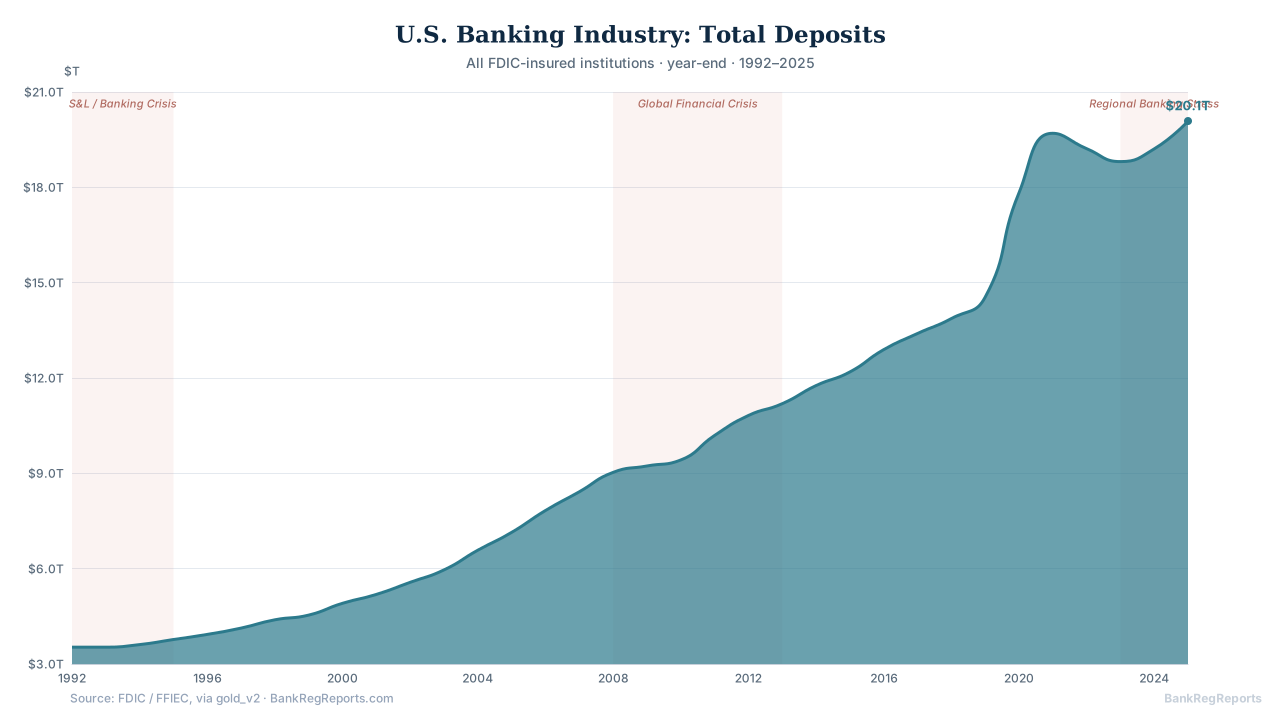
Deposits Are Not All Created Equal
A bank’s deposits range from extremely stable to extremely flighty, and the difference comes down to three questions: Is the deposit insured? Is it a relationship or a rate-chasing placement? And how concentrated is it?
Core deposits sit at the stable end. These are the checking accounts, savings accounts, and smaller time deposits that customers maintain as part of an ongoing banking relationship. They are typically insured, operationally entangled with the customer’s daily life, and slow to leave even when a higher rate appears elsewhere. Core deposits are the funding base examiners and analysts prize most.
Brokered and uninsured deposits sit at the volatile end. They tend to be larger, more rate-sensitive, less relationship-driven, and far quicker to exit at the first sign of stress.
What Are Uninsured Deposits?
The FDIC insures deposits up to $250,000 per depositor, per insured bank, per ownership category. Any balance above that limit is uninsured — the depositor, not the FDIC, bears the loss if the bank fails.
Uninsured depositors behave very differently from insured ones. An insured customer has little reason to flee a troubled bank; their money is protected regardless. An uninsured depositor — often a business with payroll to make or a large balance that exceeds the limit many times over — has every reason to pull funds at the first hint of trouble. That asymmetry is exactly what turns a rumor into a run.
Silicon Valley Bank was the extreme case: more than 85% of its deposits were uninsured. When confidence cracked, there was almost no insured, sticky base to slow the outflow. (Sources: Time: 85% of SVB’s deposits were uninsured; CNBC.) In response, regulators invoked the statutory systemic risk exception to guarantee all deposits at SVB and Signature Bank — an extraordinary step that underscored how dangerous a heavily uninsured deposit base had become. (Source: FDIC press release, March 12, 2023.)
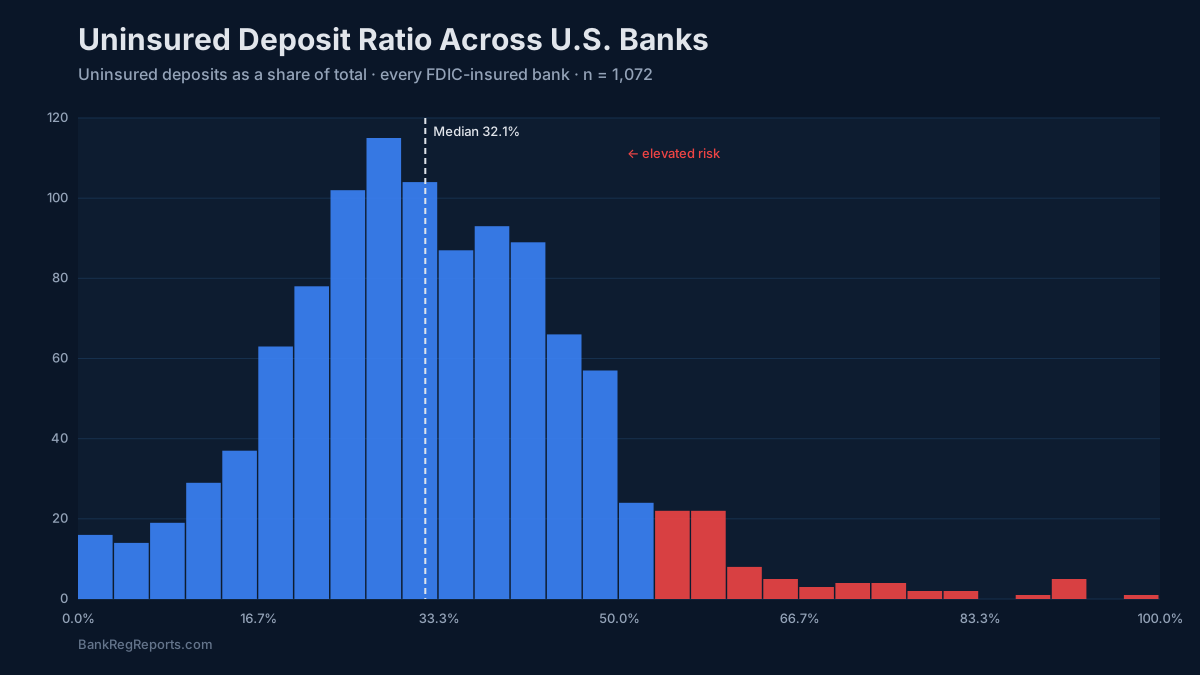
Across the system, uninsured balances remain large and move with the rate environment. The FDIC’s Q4 2025 Quarterly Banking Profile reported that estimated uninsured domestic deposits rose by $214.7 billion in a single quarter. (Source: FDIC Quarterly Banking Profile Q4 2025.)
What Are Brokered Deposits?
Brokered deposits are funds a bank obtains through a third-party deposit broker rather than directly from its own customers. A broker gathers money from many savers — often chasing the highest available rate — and places it with whichever bank is paying most. For the bank, brokered deposits are a fast way to raise funding. That convenience is also their danger.
Brokered deposits are hot money. The depositors have no relationship with the bank and no loyalty beyond the rate. When the bank’s promotional rate matures or a better rate appears, the money leaves. A bank that funds long-dated loans with short-dated brokered money is exposed to a sudden, correlated outflow precisely when it can least afford one.
Regulators have long viewed heavy reliance on brokered deposits as a risk marker. Banks that are less than well-capitalized face restrictions on accepting or renewing brokered deposits, and rapid brokered-deposit growth is a classic supervisory flag for a bank trying to outrun its own problems.
Reciprocal Deposits: A Nuance Worth Knowing
Not every large or networked deposit is unstable. Reciprocal deposits — where banks swap deposits through a network so that each customer stays under the $250,000 insurance cap across multiple institutions — let a bank offer full insurance coverage on large balances while keeping the relationship local. The Economic Growth, Regulatory Relief, and Consumer Protection Act of 2018 recognized this by excluding qualifying reciprocal deposits from the brokered-deposit definition, up to the lesser of $5 billion or 20% of a bank’s total liabilities. The FDIC implemented the change in 2019. (Sources: Cleveland Fed: Reciprocal Deposits and the Banking Turmoil of 2023; Congressional Research Service.)
The practical lesson: when you see large or networked deposits, distinguish relationship-based reciprocal deposits from pure rate-chasing brokered money. They carry very different risk.
The Lessons of 2023
The 2023 failures rewrote the playbook on deposit risk. Three forces combined:
- A heavily uninsured deposit base that had every incentive to run.
- Concentration — deposits clustered in a single industry or network, so that customers talked to one another and moved in unison.
- Unrealized securities losses that meant the bank could not sell assets to meet outflows without crystallizing losses that threatened its capital.
The interaction is what proved fatal. A bank can survive uninsured deposits if its securities are liquid. It can survive unrealized losses if its deposits are sticky. The danger lies in holding flighty funding and an underwater securities book at the same time — which is why modern funding analysis always reads the deposit base and the securities portfolio together.
How to Analyze a Bank’s Deposit Stability
The call report and UBPR contain everything you need to assess funding quality. The key things to examine:
- Uninsured deposit share. What percentage of total deposits exceeds the insurance limit? A high share means a larger pool of run-prone money.
- Brokered deposit share and growth. How much funding comes from brokers, and is it growing rapidly? Fast growth is a red flag.
- Core deposit ratio. What proportion of funding is stable, relationship-based core deposits? Higher is safer.
- Non-core funding dependence. The UBPR’s net non-core funding dependence ratio captures reliance on volatile wholesale sources, including brokered deposits and Federal Home Loan Bank advances.
- Loan-to-deposit ratio. A very high ratio means the bank has little deposit cushion and may lean on wholesale funding to grow.
- Concentration. Is the deposit base spread across many unrelated customers, or clustered in one industry or a handful of large accounts?
No single figure settles the question. A bank with 40% uninsured deposits and a stable, diversified base is in a different position than one with the same percentage concentrated in a single volatile sector. Reading these metrics together — and tracking their trend — is how you separate genuine funding risk from a headline number.
How BankRegReports Makes Funding Analysis Easier
Deposit composition is buried across several call report schedules and standardized in the UBPR. BankRegReports surfaces it directly: brokered deposits, estimated uninsured deposits, core deposit ratios, and non-core funding dependence for every U.S. bank, charted across 24+ years and benchmarked against custom peer groups. With Sentry Alerts you can flag a bank whose brokered or uninsured reliance crosses a threshold — the kind of early signal that mattered most in 2023. If you are a depositor simply asking whether your bank is safe, deposit stability belongs near the top of your checklist.
Start for free — no credit card required →
Frequently Asked Questions
What is the difference between brokered and core deposits? Core deposits are stable, relationship-based funds — checking, savings, and smaller time deposits held by a bank’s own customers. Brokered deposits are funds placed by third-party brokers chasing the highest rate, with no customer relationship. Core deposits are far stickier; brokered deposits are rate-sensitive “hot money” that can leave quickly.
Are uninsured deposits dangerous? Uninsured deposits — balances above the FDIC’s $250,000 limit — are not inherently dangerous, but a high concentration of them increases run risk because those depositors have a strong incentive to flee at the first sign of trouble. Silicon Valley Bank had more than 85% uninsured deposits when it failed in 2023.
How much does the FDIC insure? The FDIC insures deposits up to $250,000 per depositor, per insured bank, per ownership category. Balances above that limit are uninsured unless covered by an extraordinary measure such as the systemic risk exception used in 2023.
Why do regulators restrict brokered deposits? Brokered deposits can fund rapid, risky growth and tend to leave quickly when rates change or stress appears. Banks that are less than well-capitalized face restrictions on accepting or renewing brokered deposits, and rapid brokered-deposit growth is a recognized supervisory warning sign.
What are reciprocal deposits? Reciprocal deposits are large deposits spread across a network of banks so each portion stays under the $250,000 insurance cap, giving the customer full coverage while keeping the relationship at the original bank. Since 2018, qualifying reciprocal deposits are generally excluded from the brokered-deposit definition up to the lesser of $5 billion or 20% of a bank’s liabilities.
How can I tell if a bank relies too much on volatile funding? Review the bank’s brokered deposit share, estimated uninsured deposit share, core deposit ratio, and the UBPR’s net non-core funding dependence ratio, and track their trend over time. BankRegReports presents these metrics for every U.S. bank with peer comparisons.