What Is the Loan-to-Deposit Ratio? A Bank Guide
Three banks failed in 2023 with loan-to-deposit ratios that looked fine on the surface. The ratio was not their problem — their deposit composition was. That distinction is exactly why …
Three banks failed in 2023 with loan-to-deposit ratios that looked fine on the surface. The ratio was not their problem — their deposit composition was. That distinction is exactly why the loan-to-deposit ratio (LDR) is useful as a first screen and dangerous as a final answer.
This guide covers what the loan-to-deposit ratio measures, where the numbers come from in the call report, what the healthy range actually looks like across the industry, and what the extremes are telling you — including what they are not telling you.

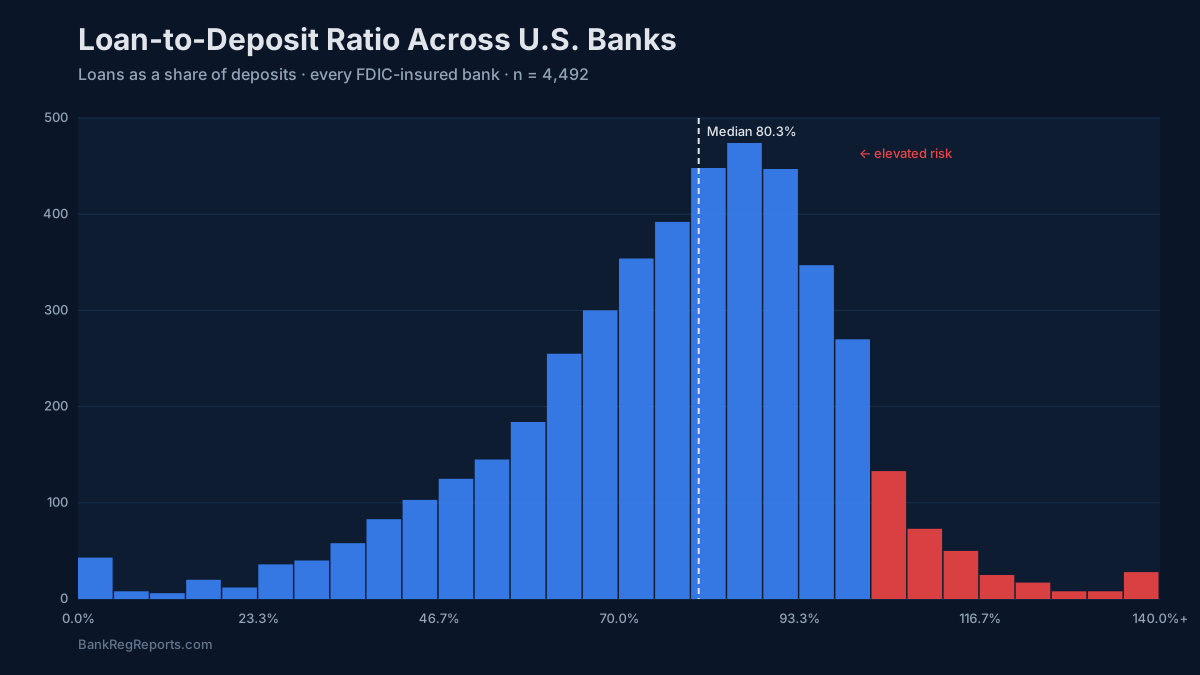
The distribution above is not symmetric. Most banks cluster between 60% and 85%. The right tail — banks running above 100% — is where the interesting conversations happen in ALCO.
What the Loan-to-Deposit Ratio Actually Measures
The formula is simple: total loans and leases divided by total deposits, expressed as a percent.
Loan-to-Deposit Ratio = Total Loans ÷ Total Deposits
An LDR of 85% means the bank has put 85 cents of every deposit dollar into loans, keeping the remainder in securities, cash, and other assets. That 15-cent buffer is what stands between the bank and a liquidity problem if depositors want out faster than loans can be liquidated.
The tension built into the ratio is real. Loans yield more than Treasuries and fed funds. So a higher LDR generally means better net interest margin — up to the point where it doesn’t, because funding costs spike and access to wholesale markets starts pricing in the risk.
Where the Numbers Come From
On the FFIEC 031/041/051 (call report), total loans and leases come from Schedule RC-C, Part I. The aggregate figure — RCON2122 for consolidated domestic and foreign, or RCON1400 if you want net of unearned income — feeds into the balance sheet at Schedule RC as RCON2122. Total deposits sit on Schedule RC as RCON2200, the sum of domestic deposits (RCON2210) plus any foreign deposits (RCFN2200) for banks filing the 031.
The UBPR presents the net loans-and-leases-to-deposits ratio as a pre-calculated peer-compared figure. The UBPR line maps to RIAD codes for the income items and RCON codes for the balance sheet stocks, so if you want to reconstruct it yourself from raw data you can — though the UBPR peer group comparison is usually what analysts want anyway.
For holding companies, the FRY-9C captures consolidated loans (BHCK2122) and deposits (BHCK2200) on Schedule HC-C and HC-E respectively. Credit unions report equivalent figures on the NCUA 5300.
Here is how to pull it programmatically:
from bankregreports import BankReg

brr = BankReg("brr_your_key_here")

# Pull quarterly LDR history for a specific bank by RSSD ID
ldr = brr.bank_metric(
    rssd_id=1015893,          # Example: a mid-size community bank
    metric="loan_to_deposit_ratio",
    periods=24                 # 24 quarters of history
)

print(ldr.tail(4))
# report_date    loan_to_deposit_ratio    peer_median
# 2025-03-31     0.8712                   0.7634
# 2025-06-30     0.8841                   0.7698
# 2025-09-30     0.9107                   0.7711
# 2025-12-31     0.9203                   0.7689
# <BankRegSeries rssd=1015893 metric=loan_to_deposit_ratio n=24>
That upward trend from 87% to 92% over four quarters is worth flagging. Peer median stayed flat. That kind of divergence is what you bring to ALCO.
BankRegReports calculates this ratio for every FDIC-insured bank and credit union, with 24+ years of quarterly history and custom peer group benchmarking built in.
What a Healthy Range Looks Like
Industry data clusters most banks between 65% and 90%. The table below reflects where examiners start paying closer attention:
| LDR Range | What It Suggests |
|---|---|
| Below 60% | Deposits sitting underdeployed; earnings drag likely |
| 60% – 90% | Typical operating range; liquidity buffer intact |
| 90% – 100% | Aggressive; funding mix and deposit stability matter a lot here |
| Above 100% | Loans exceed deposits; non-deposit funding is filling the gap |
The 70%-to-90% range is not a rule — it is an observation about where most well-run banks land. A bank in a hypergrowth market might run 95% and manage it fine. A bank in a declining rural market might sit at 55% because loan demand simply is not there. Context matters. Trend matters more than a point-in-time number.
What a High LDR Is Actually Telling You
When a bank’s LDR pushes above 90%, the ratio itself is not the problem. The question it forces is: what is funding the excess? Loans that exceed core deposits have to be funded by something — Federal Home Loan Bank advances, brokered deposits, wholesale repo, or other non-core sources.
Those sources carry real risks. They tend to be rate-sensitive and short-duration. They can reprice sharply. And in a stress scenario — a credit event, a rumor, a ratings action — they can vanish in 24 hours. Silicon Valley Bank’s LDR was actually moderate. Its problem was uninsured deposit concentration. The LDR would not have flagged it early; the brokered and uninsured deposit metrics would have.
Examiners looking at a high LDR will immediately want to see the net non-core funding dependence ratio, the composition of the deposit book (Schedule RC-E breaks out time deposits by size tier, including RCON6648 and RCON6646 for those over and under $250K), and the liquidity coverage position. The LDR opens the conversation; it does not close it.

The scatter matters because two banks at 95% LDR can have completely different risk profiles depending on whether that last 5%-10% is funded by stable municipal deposits or overnight brokered money.
What a Low LDR Is Actually Telling You
A bank at 45% LDR is not automatically safe. It is, however, definitely leaving money on the table. Loans yield more than investment securities, which yield more than fed funds. A bank sitting on unused deposit capacity in a reasonable credit environment is either operating in a weak loan market, running an unusually conservative credit posture, or both.
Neither of those is necessarily wrong as a strategy. But the return-on-equity implications are real, and a persistently low LDR relative to peers is a conversation shareholders and examiners will both want to have.
Where the Ratio Sits in a Full Liquidity Analysis
The LDR is a screening metric. It gets you to the right questions fast. But a complete liquidity picture requires at least:
- Deposit stability: core deposits vs. non-core (Schedule RC-E detail, UBPR peer comparisons)
- Investment portfolio liquidity: what is held-to-maturity versus available-for-sale, and what is the unrealized loss position (RCON1771, RCON1772)
- Wholesale funding reliance: FHLB advances (RCON3123), brokered deposits (RCON2365), and large time deposits
- Off-balance-sheet commitments: unfunded loan commitments (Schedule RC-L) that could draw down liquidity quickly
A bank running 88% LDR with deep core deposits, a liquid AFS portfolio, and no material FHLB dependence is in a different position than one at 82% propped up by $200M in brokered CDs repricing in 90 days. The ratio alone cannot tell you which is which.
BankRegReports surfaces these companion metrics alongside the LDR — deposit composition, non-core funding ratios, FHLB advance trends — so you can move from the initial screen to a real assessment without manually assembling FFIEC data.
Frequently Asked Questions
What is a good loan-to-deposit ratio for a bank? Most banks operate in the 70%–90% range. Below 60% often signals underdeployed deposits and an earnings drag; above 90% means a thinner liquidity buffer and more reliance on non-core funding. Above 100% means loans exceed deposits and the shortfall is funded by borrowings or brokered money.
How is the loan-to-deposit ratio calculated? Total loans and leases (Schedule RC-C, RCON2122) divided by total deposits (Schedule RC, RCON2200), expressed as a percentage. Both come from the quarterly call report balance sheet.
What does a loan-to-deposit ratio above 100% mean? The bank has lent out more than it holds in deposits. The gap is funded by non-deposit sources — FHLB advances, brokered deposits, wholesale borrowings — which are generally less stable and more expensive than core deposits, especially in a stress event.
Is a low loan-to-deposit ratio good or bad? Safe from a liquidity standpoint, but often a drag on profitability. Whether it is a problem depends on why it is low: weak loan demand, tight credit standards, or a deliberate strategy each carry different implications.
Does the loan-to-deposit ratio fully measure liquidity risk? No. It does not distinguish stable core deposits from volatile brokered money, and it says nothing about the liquidity of the assets on the other side of the balance sheet. Use it as a first screen, then go deeper.
Where can I find a bank’s loan-to-deposit ratio? It is derived from the call report and pre-calculated in the UBPR. The BankRegReports API returns it for every U.S. bank with historical trend data and peer group context.
The data referenced in this post is available through the BankRegReports Data API. The BankRegAPI Python SDK (pip install bankregreports) returns clean, UBPR-validated data from FFIEC, FDIC, Federal Reserve, NCUA, and SEC EDGAR in a single call. Get a free API key →