Tangible Common Equity (TCE): What It Measures and Why Banks Can't Hide From It
In March 2023, Silicon Valley Bank had a CET1 ratio above 15 percent — technically well-capitalized by every regulatory threshold. Its tangible common equity ratio told a different story. When …
In March 2023, Silicon Valley Bank had a CET1 ratio above 15 percent — technically well-capitalized by every regulatory threshold. Its tangible common equity ratio told a different story. When you subtracted the unrealized losses accumulating in its held-to-maturity portfolio and looked at the tangible cushion actually available to absorb real losses, the picture was considerably thinner. Regulatory capital said “fine.” Tangible common equity said “watch out.”
That gap is exactly why analysts and investors have tracked tangible common equity (TCE) for decades. It is not a replacement for the regulatory ratios. It is a check on them.

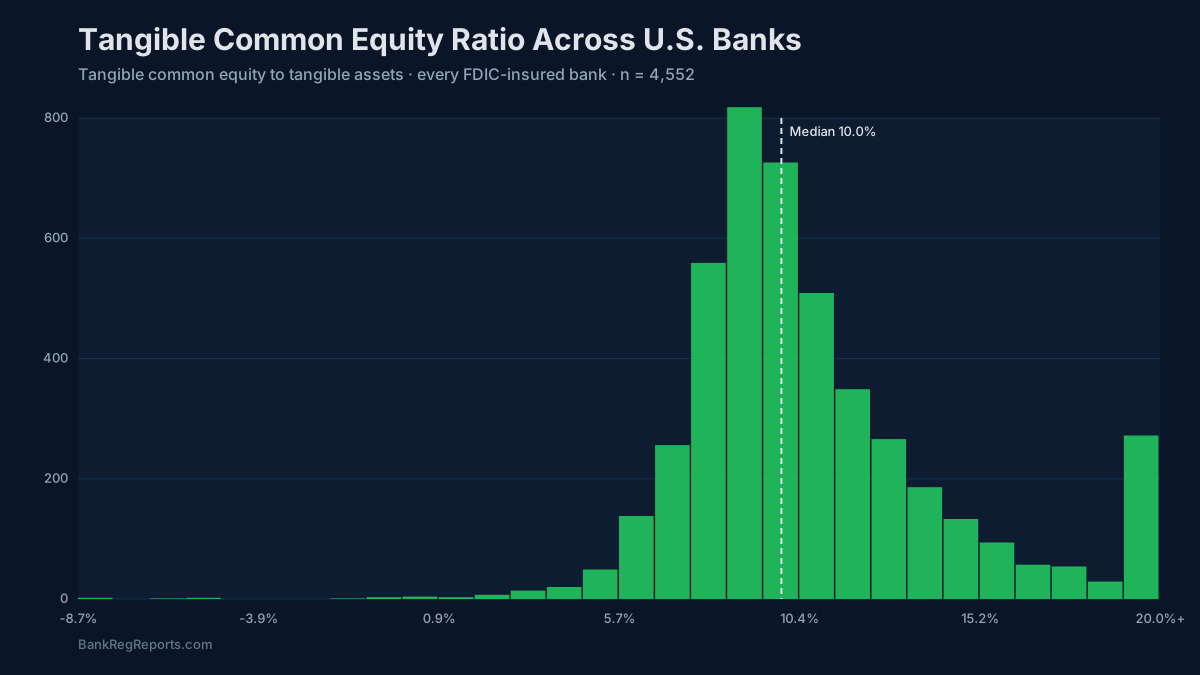
The distribution above is worth sitting with. Most banks cluster in the 8–12 percent range, but the left tail is long and the banks in it often look healthier on a risk-based basis than their tangible capital position warrants.
What Tangible Common Equity Actually Strips Out
The formal definition is straightforward:
Tangible Common Equity = Total Common Equity − Goodwill − Other Intangible Assets
On the FFIEC 041/031 call report, common equity is Schedule RC line item RCON3210 (total equity capital), adjusted for preferred stock. Goodwill sits at RCON3163. Core deposit intangibles and other acquired intangibles appear at RCON0426 and related items. Preferred stock is excluded from the numerator because it has a prior claim over common shareholders — it is not available to absorb losses on behalf of common equity holders.
What remains after those deductions is the equity that genuinely stands between the bank and insolvency.
The TCE Ratio: Leverage Without Risk-Weighting Games
Scale TCE against tangible assets and you get the ratio that most analysts actually use:
TCE Ratio = Tangible Common Equity ÷ Tangible Assets
Tangible assets are simply total assets (RCON2170) minus goodwill and intangibles. The ratio tells you how much hard equity backs each dollar of real assets. No risk weights. No credit for holding Treasuries versus corporate loans. Just equity over assets, both stripped to their tangible cores.
A closely related figure — tangible book value per share — divides TCE by diluted shares outstanding. Bank stocks get quoted and compared as multiples of tangible book value constantly. If a bank trades at 1.8× tangible book, investors are paying a premium; below 1.0× is a signal the market thinks equity destruction is possible.
Worked Example
| Item | Amount |
|---|---|
| Total common equity (RCON3210 adjusted) | $90 million |
| Less: goodwill (RCON3163) | $12 million |
| Less: other intangibles (RCON0426) | $3 million |
| Tangible common equity | $75 million |
| Total assets (RCON2170) | $1,050 million |
| Less: goodwill + intangibles | $15 million |
| Tangible assets | $1,035 million |
| TCE ratio | 7.25% |
The bank reports $90 million of equity. A stress scenario or acquisition analysis uses $75 million. That $15 million difference is not trivial when loan losses start compounding.
Why Goodwill Is the Real Problem
Goodwill appears on a bank’s balance sheet when it acquires another institution for more than the fair value of net assets. Pay $150 million for a bank worth $130 million in tangible terms, and $20 million goes on the books as goodwill. Accounting rules require it.
The problem is what goodwill cannot do. It cannot absorb loan losses. It cannot be liquidated quickly. And if the acquired business underperforms, the goodwill gets written down — which reduces equity at exactly the moment a bank can least afford it. The bank that grew by buying things at a premium now has less capital precisely when the credit cycle turns.
This is why the Texas Ratio — another blunt capital stress tool — uses tangible common equity in its denominator. Both measures are designed to work in worst-case scenarios, where accounting headroom disappears and only genuinely hard assets and genuine equity matter.
Two banks can report identical equity ratios. One grew organically; the other made three acquisitions at 1.6× book. The organic grower’s TCE ratio is meaningfully higher. That difference only shows up when you strip the goodwill.
TCE vs. the Regulatory Capital Ratios
The regulatory capital ratios — CET1, Tier 1, total risk-based capital, and the leverage ratio — exist for a different purpose. They determine prompt corrective action thresholds. They drive capital planning and stress testing requirements. Regulators use them to make formal supervisory determinations.
Those ratios are calculated against risk-weighted assets, which means holding a pool of agency MBS gets treated very differently from holding commercial real estate loans. Low-risk assets create “room” in the ratio that does not exist in the TCE calculation.
The divergence matters. A bank can build a balance sheet heavy in zero- or low-risk-weighted instruments, post strong CET1 numbers, and still run a thin TCE ratio because the total asset base is large relative to tangible equity. 2023 showed this dynamic plainly: duration risk in held-to-maturity portfolios did not flow through risk-weighted assets but absolutely flowed through tangible equity when unrealized losses were marked.

Read them together. Either one alone misses something.
Pulling TCE Data for Any U.S. Bank
The inputs are all in the public record. Common equity, goodwill, and intangibles appear on Schedule RC of the quarterly FFIEC 041 (community banks) or FFIEC 031 (banks with foreign offices). The UBPR publishes peer ratios. The FDIC’s call report database goes back to the 1990s.
Doing this at scale — computing TCE for thousands of banks, tracking it across 24 years of quarters, building peer benchmarks — is the tedious part. BankRegReports calculates TCE and the TCE ratio for every FDIC-insured institution and makes the full history accessible via the API:
from bankregreports import BankReg

client = BankReg("brr_xxx")

# Pull TCE ratio history for a single bank
tce = client.bank("0210434").metrics(
    codes=["tce_ratio", "tce_tangible_common_equity", "tangible_book_value_per_share"],
    periods=8  # trailing 8 quarters
)

print(tce)
# bank_id          period    tce_ratio    tce_tangible_common_equity    tangible_book_value_per_share
# 0210434        2025-Q4       0.0912              547_300_000                             31.42
# 0210434        2025-Q3       0.0897              531_100_000                             30.58
# 0210434        2025-Q2       0.0881              514_800_000                             29.71
# ...
The tce_ratio field is calculated directly from RCON3210, RCON3163, RCON0426, and RCON2170 — the same call report line items, validated against UBPR peer ratios. You can also pull peer group medians in the same call to benchmark against institutions of similar size and charter type.
Frequently Asked Questions
What is tangible common equity? Tangible common equity (TCE) is a bank’s common shareholders’ equity minus goodwill and other intangible assets. It isolates the equity that can genuinely absorb losses — the capital that remains after removing items that carry no liquidation value in a crisis.
How is the TCE ratio calculated? TCE ratio equals tangible common equity divided by tangible assets. Tangible assets are total assets minus goodwill and intangibles. The result is a leverage-style measure independent of risk weighting.
Why is goodwill excluded from tangible common equity? Goodwill cannot absorb losses. It cannot be sold quickly in a stress scenario, and it may be written down — reducing equity — if an acquired business underperforms. Excluding it reflects what equity is actually available when things go wrong.
What is the difference between TCE and CET1? CET1 is a regulatory ratio measured against risk-weighted assets that determines whether a bank is well-capitalized under Basel III rules. The TCE ratio is measured against total tangible assets with no risk-weighting adjustment. Both matter; they measure different things.
What is tangible book value per share? Tangible book value per share divides TCE by diluted shares outstanding. It is the most common valuation anchor for bank equities. A stock trading below 1.0× tangible book implies the market expects further equity erosion.
Where can I find a bank’s tangible common equity data? The raw inputs — RCON3210, RCON3163, RCON0426, RCON2170 — are in the public call report filings. BankRegReports computes TCE and the TCE ratio for every U.S. bank across 24 years of quarterly history and surfaces peer group benchmarks alongside the regulatory capital ratios.
If you are doing this analysis manually, the main thing to watch for is timing: goodwill impairments often lag the credit problems that caused them. A bank’s TCE can look stable for several quarters after an acquisition goes bad, then drop sharply when the write-down finally hits. Build in the forward expectation, not just the current balance sheet number.
The data referenced in this post is available through the BankRegReports Data API. The BankRegAPI Python SDK (pip install bankregreports) returns clean, UBPR-validated data from FFIEC, FDIC, Federal Reserve, NCUA, and SEC EDGAR in a single call. Get a free API key →