Bank Charter Types: National vs. State, and Why It Matters
Of the roughly 3,800 FDIC-insured commercial banks operating today, about 665 hold national charters. The other 3,100-plus are state-chartered, either members of the Federal Reserve System or not. That three-way …
Of the roughly 3,800 FDIC-insured commercial banks operating today, about 665 hold national charters. The other 3,100-plus are state-chartered, either members of the Federal Reserve System or not. That three-way split determines who examines your bank, who issues enforcement actions when things go wrong, and which regulatory database you need to search when reviewing a peer institution. Starting an analysis without knowing the charter type is like reviewing a loan file without checking the borrower’s name.
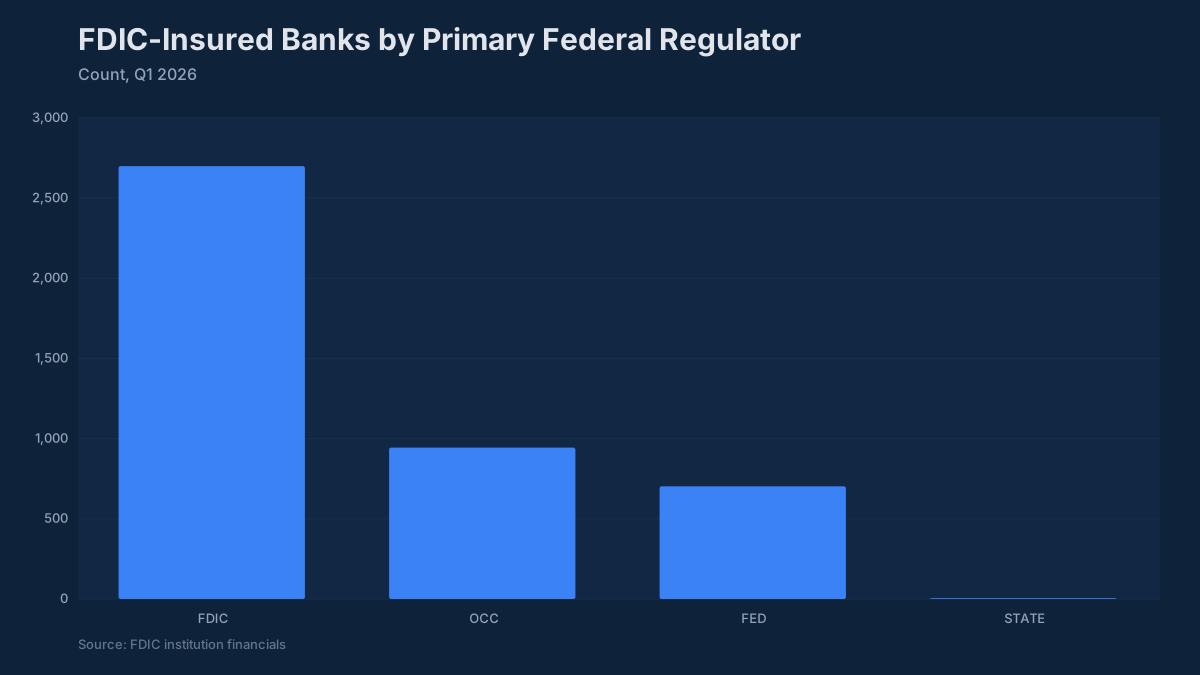
The distribution has a practical implication for peer analysis: FDIC-supervised state nonmember banks outnumber OCC-supervised national banks by roughly 3.7 to 1 in institution count, but national banks hold a disproportionate share of total industry assets because the largest institutions overwhelmingly choose the national charter. When you build a peer group of $500M–$2B community banks, you are most likely working mostly with state nonmember institutions.
The Dual Banking System: Two Parallel Tracks Since 1863
Most countries have a single chartering authority for banks. The U.S. has two parallel tracks running simultaneously: a federal track administered by the Office of the Comptroller of the Currency, and fifty separate state tracks administered by state banking departments. Both produce legitimate deposit-taking institutions. Both are subject to federal oversight. They differ in who grants the charter, who conducts the primary examination, and which body issues consent orders and formal agreements when problems emerge.
This arrangement dates to the National Bank Act of 1863, which created the OCC partly to fund the Civil War and partly to establish a uniform national currency. State charters predate that by decades. The two systems have coexisted since, with banks periodically converting between them when the supervisory or business environment shifts.
A second distinction layers on top of the federal/state split. State-chartered banks may or may not elect membership in the Federal Reserve System. That decision changes the primary federal regulator for state banks, splitting them into two distinct categories. The full picture has three buckets, not two.

The Three Charter Types and Who Supervises Each
Every FDIC-insured commercial bank falls into one of these categories:
| Charter Type | Chartered By | Primary Federal Regulator |
|---|---|---|
| National bank | OCC (federal) | Office of the Comptroller of the Currency |
| State member bank | State banking authority + Fed membership | Federal Reserve |
| State nonmember bank | State banking authority | FDIC |
National banks carry “National Association” or “N.A.” in their legal name. The OCC charters them, examines them, and issues their enforcement orders. Membership in the Federal Reserve System is mandatory for national banks (12 U.S.C. 222), so the member or nonmember choice exists only for state-chartered banks. The OCC has historically been the chartering home for the country’s largest institutions, and its examination staff carries deep expertise in complex products and multi-state operations.
State member banks are state-chartered institutions that have applied for and been granted Federal Reserve membership. The Fed becomes the primary federal regulator, even though the state issued the charter. State member banks tend to cluster in the mid-size and regional tier, large enough to value the Fed’s expertise and payment system access, but still operating under a state framework that may offer permissible-activity flexibility.
State nonmember banks are state-chartered and have not joined the Fed. The FDIC serves as primary federal regulator. This is where most community banks sit: institutions with $300M to $2B in assets, deep local market knowledge, and no particular need for the additional layer of Fed membership. If you are a CFO at a community bank, there is better than a 50% chance this describes your institution.
In every case, state-chartered banks remain subject to their state banking department alongside the federal regulator. And every FDIC-insured bank, regardless of charter, answers to the FDIC on deposit insurance matters. Credit unions fall outside this structure entirely: they are chartered and examined by the NCUA and file the NCUA 5300 Call Report, not the FFIEC forms.
Why Banks Choose One Charter Over Another
Charter selection is a genuine strategic decision, not an administrative default. Banks weigh several factors when they choose a charter or consider converting.
The supervisory relationship itself matters more than most analysts acknowledge. Bankers who have dealt with both OCC examiners and their state regulator will tell you the cultures differ: examination philosophy, examiner continuity, turnaround time on novel-product approval requests, and willingness to engage pre-exam. Some banks prefer the OCC’s specialized expertise in specific lending or product areas. Others value the relationship continuity that comes from working with the same state examiner team over many cycles.
Permissible activities and lending limits can diverge between national and state charters. States occasionally authorize activities or set lending limits that differ from the OCC’s framework, and some banks have sought or retained state charters specifically to preserve those powers in their home market. This calculus has shifted over the decades as federal preemption doctrine has expanded and contracted.
Geographic expansion favors national charters. A bank operating across multiple states gets a uniform federal framework from the OCC, which simplifies legal and compliance operations compared to managing simultaneous relationships with multiple state banking departments.
Banks convert between charter types more often than most analysts realize. A charter conversion changes the primary federal regulator, sometimes the examination schedule, and occasionally the supervisory tone. When you see a conversion in a bank’s regulatory history, it is worth understanding why: it sometimes reflects dissatisfaction with the prior regulator, sometimes a change in business strategy, and occasionally a response to an examination that was not going well.
What the Charter Does Not Change
The charter shapes supervision. It does not change the financial reporting format, and that distinction matters enormously for cross-bank analysis.
Every FDIC-insured commercial bank, whether national, state member, or state nonmember, files the same standardized call report regardless of charter type. Banks with foreign offices, and banks with $100 billion or more in total assets, file the FFIEC 031. Banks with domestic offices only file the FFIEC 041, or the shorter FFIEC 051 if they have less than $5 billion in assets and a simpler structure. Most community banks file the 051. The form choice depends on size and complexity, not charter. A national bank and a state nonmember bank of similar size file the same form and report their financials in exactly the same format.
This standardization is what makes cross-charter comparison possible. Schedule RC (Balance Sheet), Schedule RI (Income Statement), Schedule RC-C (Loans and Leases), Schedule RI-B (Charge-offs and Recoveries): these schedules are identical across charter types. RCON2170 is total assets for a national bank and a state nonmember bank alike. The same NIM, ROA, CET1, and efficiency ratio benchmarks apply regardless of who your examiner is.
For community banks as of Q1 2026: NIM was running around 3.6–3.8% for the peer group. ROA in the 0.95–1.10% range is typical, with strong institutions above 1.20% and weak ones below 0.80%. Efficiency ratios below 60% are excellent; above 70% draws examiner attention regardless of charter. CET1 medians sit around 13% for community banks, well above the 6.5% well-capitalized minimum, but examiners at both the OCC and FDIC are watching whether that buffer is adequate given CRE concentrations.
The UBPR, the Uniform Bank Performance Report, is similarly structured and covers all charter types on the same peer group framework. When examiners walk in, they will compare your bank to UBPR peers. Since February 26, 2026, that peer selection is based on asset size alone, not charter type.
The Holding Company Layer
The charter governs the bank subsidiary. It says nothing about the organization above it.
Bank holding companies are regulated by the Federal Reserve at the parent level, regardless of what charter the subsidiary bank holds. A national bank supervised by the OCC can be owned by a holding company that is simultaneously subject to Federal Reserve oversight. This means a single banking organization can involve the OCC, the Federal Reserve, and a state banking department, each with a distinct scope of authority and examination calendar.
Financial holding companies, a designation under Gramm-Leach-Bliley, add another layer. FHC status allows broader financial activities but comes with additional Federal Reserve oversight and capital requirements at the consolidated level. Holding company structure is a separate analysis from charter type, though the two interact constantly in examinations and enforcement.
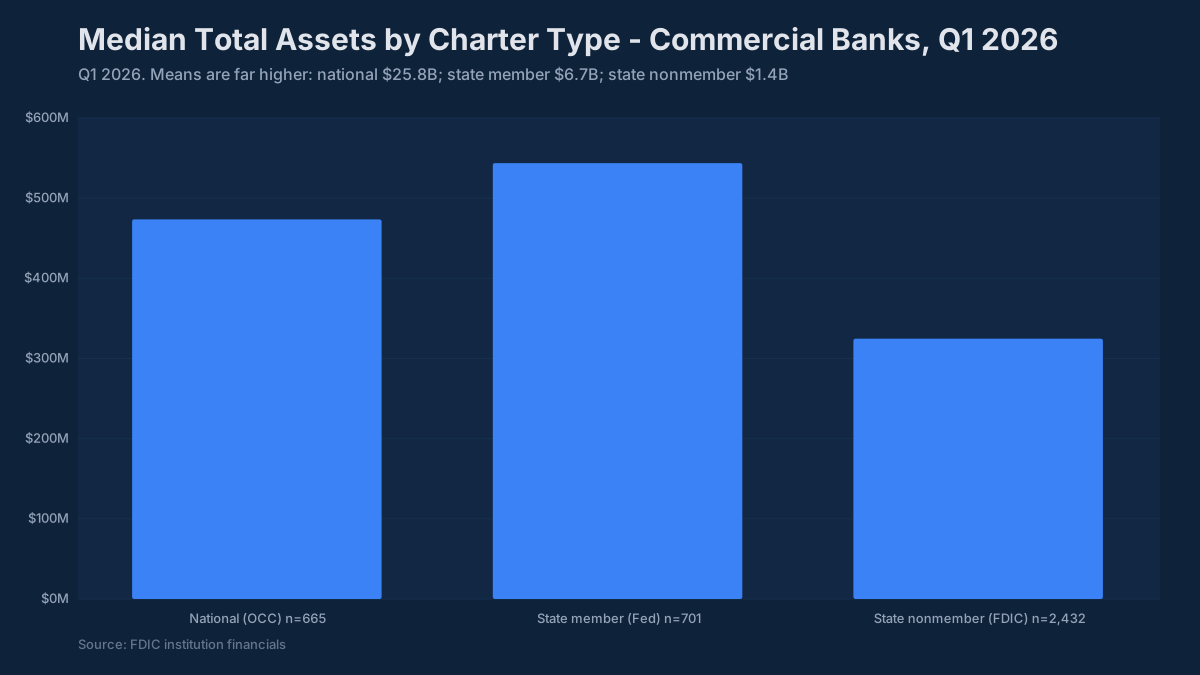
The asset size disparity is real and should inform peer selection. National bank averages are pulled up by the GSIBs and the large-regionals. The typical national bank by count is not JPMorgan: the median national bank held about $474 million in assets at March 31, 2026, and chose the OCC for operational or supervisory reasons. State nonmember banks are overwhelmingly community institutions, with medians below $500M. Any peer group analysis should control for asset size within charter type, not treat charter type as a size proxy.
Working With Charter Data
The FDIC assigns each institution a certificate number and tracks charter type, primary regulator, and regulatory agency codes through its Statistics on Depository Institutions database. BankRegReports surfaces this alongside financial data, so you can identify an institution’s charter type, examiner, and regulatory filing history without cross-referencing multiple agency databases.
The charter_class field follows FDIC encoding: N for national bank, SM for state member, NM for state nonmember, SB for savings bank, and additional codes for thrift and mutual savings institutions.
Frequently Asked Questions
What is the difference between a national bank and a state bank? A national bank is chartered and supervised at the federal level by the OCC and carries “N.A.” or “National Association” in its legal name. A state bank is chartered by a state banking authority and supervised federally by either the Federal Reserve (if it is a Fed member) or the FDIC (if it is not), plus its state regulator.
What is the dual banking system? The arrangement under which a bank can be chartered either by the federal government through the OCC or by a state banking authority. Both produce FDIC-insured institutions subject to federal oversight. The primary difference is who grants the charter and who conducts federal examinations.
Who regulates each charter type? National banks: OCC. State member banks: Federal Reserve (primary federal) plus state regulator. State nonmember banks: FDIC (primary federal) plus state regulator. All three types are FDIC-insured. Credit unions are separate, regulated by the NCUA.
Does a bank’s charter affect its call report format? No. All FDIC-insured commercial banks file the same FFIEC call report: 031, 041, or 051 based on size and complexity, not charter type. Item codes and MDRM numbers are identical across charter types, which is what makes direct financial comparison possible.
Can a bank change its charter? Yes, and it happens with some regularity. A bank can convert from a national to a state charter or the reverse, changing its primary federal regulator in the process. Charter conversions sometimes reflect a strategic shift, sometimes a preference for a different supervisory relationship, and occasionally a response to examination pressure from the prior regulator.
What does charter type mean for CRE concentration analysis? Nothing directly. The 2006 interagency CRE guidance applies uniformly across all charter types: total CRE at or above 300% of total risk-based capital with 50% growth over 36 months, or construction at or above 100%, flags a bank for closer review. Whether your examiner is OCC, Fed, or FDIC, meeting those screens without documented risk management policies will draw the same kind of heightened scrutiny.
The data in this post is available through the BankRegReports platform. Pull peer benchmarks, Call Report metrics, UBPR trends, and enforcement history for any FDIC-insured bank, no data engineering required.