FDIC Deposit Insurance: Limits and Ownership Categories
Silicon Valley Bank held $161.5 billion in domestic deposits as of December 31, 2022. Of that, $151.6 billion, roughly 94%, was estimated to sit above the FDIC's $250,000 coverage limit. …
Silicon Valley Bank held $161.5 billion in domestic deposits as of December 31, 2022. Of that, $151.6 billion, roughly 94%, was estimated to sit above the FDIC’s $250,000 coverage limit. That figure was not hidden; it was filed quarterly on Schedule RC-O of the call report, available to anyone with access to FFIEC bulk data. When the run started in March 2023, the 94% was not the cause, but it was the accelerant. Uninsured depositors had every rational reason to move first.
FDIC deposit insurance is the reason bank failures have become mundane administrative events rather than financial panics. Since 1933, no depositor has lost a cent of insured funds. That record is real. But the rules around the $250,000 limit are routinely misunderstood, and the misunderstanding carries direct financial consequences: for businesses with large operating balances, for high-net-worth depositors, and for anyone evaluating a bank as a counterparty rather than just a place to keep money.
How FDIC Deposit Insurance Actually Works
The Federal Deposit Insurance Corporation was created by the Banking Act of 1933 after roughly 4,000 banks failed in a single year during the Depression, wiping out depositors who had no other recourse. The FDIC’s core function is straightforward: if an insured bank fails, the FDIC repays insured balances, typically within days, usually by transferring accounts to an acquiring institution. The average resolution time for recent bank failures has been measured in weekends, not months.
The guarantee does something beyond protecting individual depositors. It removes the rational incentive to run. If your deposits are fully insured, panic-driven withdrawals make no financial sense. That circuit-breaker explains why retail depositors played almost no role in the 2023 failures; it was business accounts and institutional depositors, mostly uninsured, who moved.
FDIC membership covers commercial banks and savings institutions. Credit unions operate under the National Credit Union Administration (NCUA) with a parallel $250,000 limit through the Share Insurance Fund. These are separate programs. Confirming which agency covers a specific institution is a one-minute check that most people skip.
The standard coverage formula is: $250,000 per depositor, per insured bank, per ownership category.
Each of those qualifiers is doing real work.
Per Depositor, Per Bank, Per Ownership Category
Per depositor means coverage tracks who owns the funds. Two checking accounts at the same bank, both in your name, aggregate against a single $250,000 limit, not two separate ones. The account count is irrelevant; ownership is what the FDIC measures.
Per insured bank means deposits at separate FDIC-insured institutions are insured independently. $250,000 at Bank A and $250,000 at Bank B is $500,000 of total insured coverage. Spreading deposits across banks is the simplest way to multiply protection, and it requires nothing more than opening accounts.
Per ownership category is where most depositors leave money exposed without realizing it. The FDIC recognizes distinct ownership categories, each of which is insured separately up to $250,000 at the same institution. A single person can hold meaningfully more than $250,000 in insured coverage at one bank by holding funds across multiple categories.
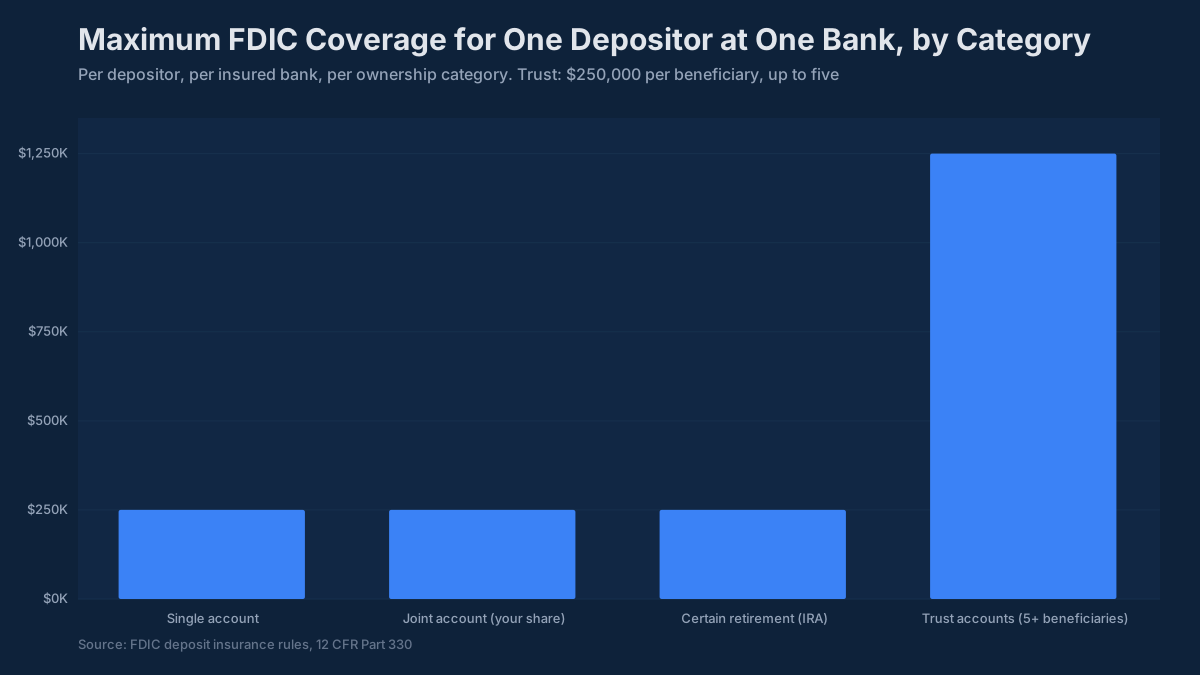
The categories the FDIC recognizes:
Single accounts are owned by one person, with no co-owners or named beneficiaries. All single accounts at one bank aggregate against a single $250,000 ceiling.
Joint accounts are owned by two or more people with equal rights to withdraw. Each co-owner’s share is insured separately up to $250,000. A standard two-person joint account is covered up to $500,000 at one bank.
Certain retirement accounts (IRAs, SEP-IRAs, and SIMPLE IRAs held at an insured bank) are insured up to $250,000 separately from the depositor’s other accounts at the same institution. A depositor with $200,000 in a savings account and $200,000 in an IRA at the same bank has $400,000 fully insured.
Trust accounts are where coverage can extend substantially, and the rule changed recently enough that most published explanations are still wrong. Since April 1, 2024 the FDIC insures revocable trusts, including payable-on-death accounts, and irrevocable trusts together under a single trust accounts category. Coverage is $250,000 per eligible beneficiary up to a maximum of $1,250,000 per owner per bank, which is five beneficiaries. All of a depositor’s trust deposits at the same bank are combined before the limit is applied, so naming a sixth beneficiary does not extend coverage. A depositor with a trust naming four beneficiaries has $1,000,000 insured at that bank. (Source: FDIC, Deposit Insurance Coverage for Trust Accounts.)
Corporate and business accounts. Corporations, LLCs, and partnerships are treated as depositors separate from their owners. A business operating account is insured up to $250,000 separately from the personal accounts of the business’s principals. For a small business carrying $400,000 in its operating account, $150,000 of that balance is uninsured exposure at a single institution.
Government accounts. Deposits of state, county, and municipal governments carry their own category with separate coverage.
The practical implication: a married couple with individual accounts, a joint account, IRAs, and a trust account at the same bank can have over $1.5 million in fully insured coverage without opening an account at a second institution. Structure, not just account size, determines how much protection you actually have.
What FDIC Coverage Includes, and What It Explicitly Does Not
Covered products are deposit instruments: checking accounts, savings accounts, money market deposit accounts (not money market mutual funds, different instruments entirely), and certificates of deposit. Negotiable order of withdrawal (NOW) accounts are covered. Official items like cashier’s checks issued by the failed bank are covered.
Not covered: anything that is not a deposit product, regardless of where it is purchased. Stocks, bonds, mutual funds, annuities, life insurance products, Treasury bills held in a brokerage account, and cryptocurrency fall outside FDIC protection even when purchased through a bank or its affiliated broker-dealer. Safe deposit box contents are not insured. The FDIC guarantee runs to the deposit, not the institution.
The distinction matters because bank-affiliated investment products are sometimes marketed in ways that obscure this line. If an account statement reflects market value rather than a fixed balance, it is most likely not a deposit product. If the product can lose principal, FDIC coverage does not apply.
Uninsured Deposit Ratios: What the Call Report Tells You
For most depositors with balances under $250,000, the mechanics above are the complete picture. For anyone carrying large operating balances, or evaluating a bank as a counterparty, the institution’s aggregate uninsured deposit exposure matters.
Banks report estimated uninsured deposits on Schedule RC-O of the FFIEC 031/041 call report, following the estimation rules set by the FDIC. The relevant MDRM code is RCON5597, Schedule RC-O, Memorandum item 2, “Estimated amount of uninsured deposits,” reported on both the FFIEC 031 and the FFIEC 041, but only by institutions with $1 billion or more in total assets. Large and highly complex institutions also report a fully consolidated figure at RCONL197, Schedule RC-O, item 17.d. The uninsured deposit ratio (uninsured deposits divided by total deposits) is a standard liquidity risk indicator that examiners track closely following the 2023 failures.
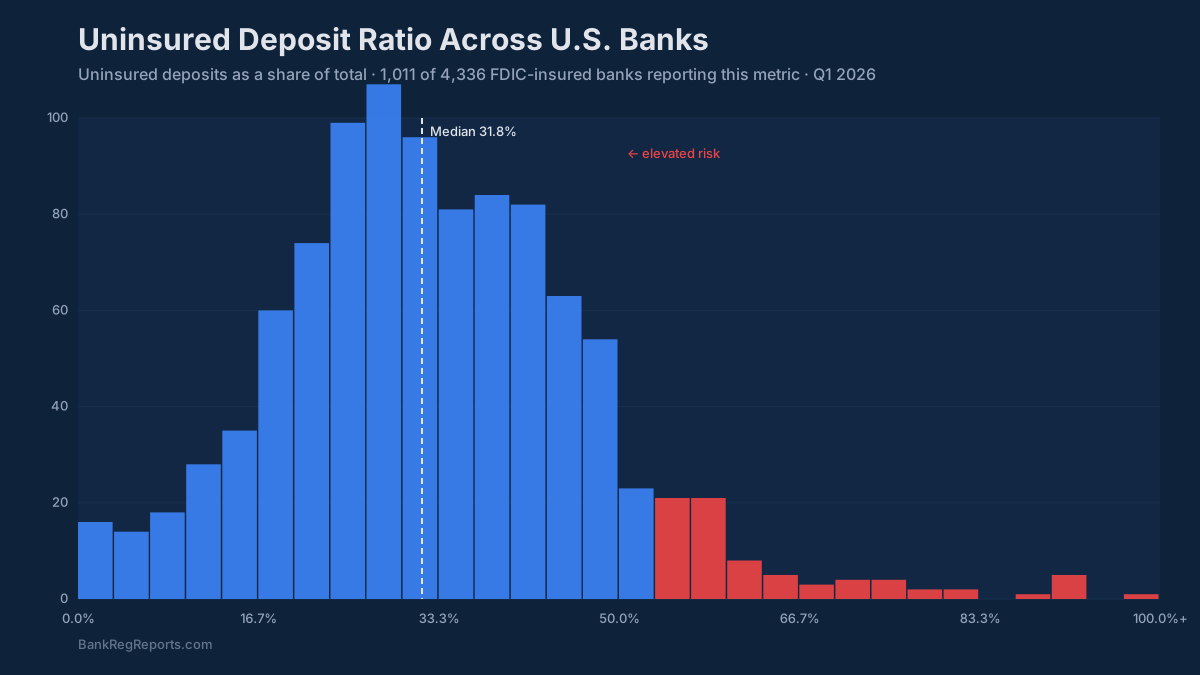
Industry-wide, the ratio runs around 40–45% across all insured institutions. Banks below $1 billion in assets do not report the estimate, so the call report gives no uninsured figure for most community banks. Tech-focused banks and large institutional custodians routinely sit at 60–80%+. SVB’s 94% was an outlier, but the direction of the distribution is not.
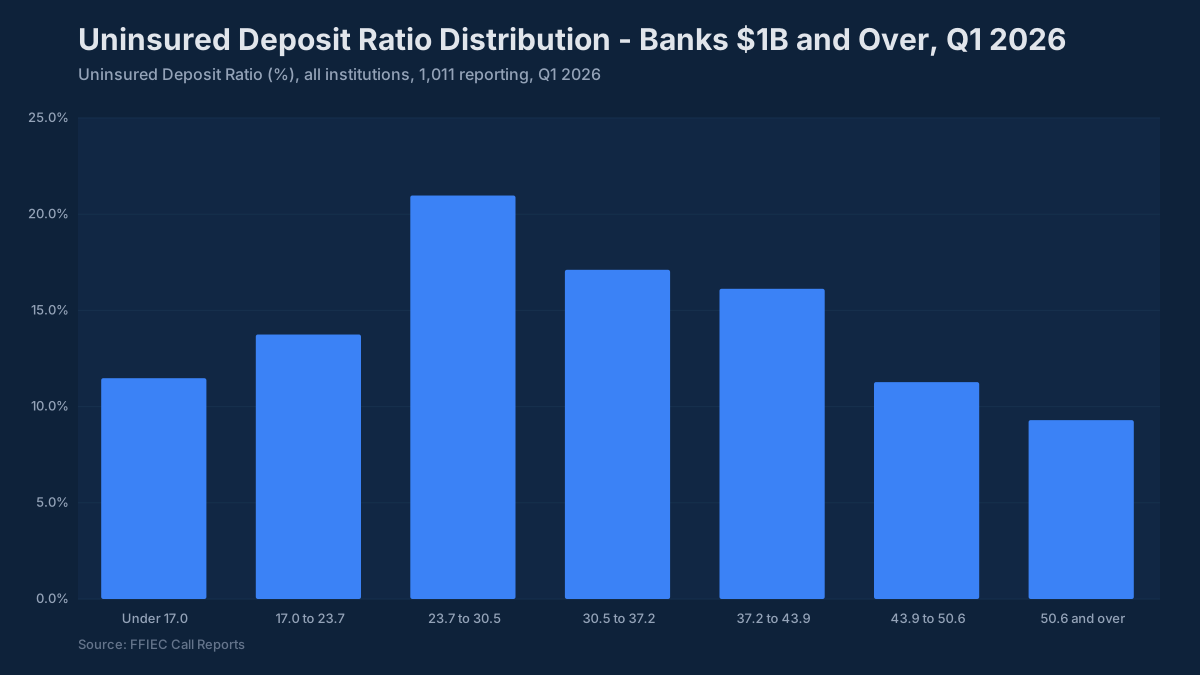
A high uninsured ratio alone does not signal distress. A bank with 65% uninsured deposits, strong capital well above the 10% total risk-based well-capitalized threshold, ample liquidity buffers, and stable depositor relationships is in a fundamentally different position than one with the same ratio and CET1 near the 6.5% well-capitalized floor. But the ratio tells you something real about who bears the loss in a stress scenario, and whether the depositor base has the composition to produce a fast run.
For a business deciding where to hold a $2 million operating reserve, knowing that figure for your primary bank is not paranoid. It is basic counterparty diligence.
BankRegReports surfaces the uninsured deposit ratio alongside capital adequacy, asset quality trends, NPL ratios, and peer comparisons for any FDIC-insured institution, all drawn from public call report filings. The data update quarterly on each filing cycle.
What Examiners Focus On Post-2023
Following the SVB and Signature failures, bank examiners have sharpened their attention to deposit concentration and liquidity. The specific questions being asked in exam cycles now include:
Depositor concentration. Are a small number of depositors responsible for a large share of total deposits? A bank where the top 20 depositors represent 40%+ of total balances has run risk that does not show up in aggregate ratios.
Correlation of uninsured deposits with rate sensitivity. Business depositors and institutional accounts tend to be more rate-sensitive than retail depositors. Banks relying heavily on uninsured business deposits may face simultaneous runoff pressure when rates rise and the operating environment softens.
Reciprocal deposit arrangements. IntraFi and similar networks allow banks to extend FDIC coverage to large depositors by spreading balances across multiple member banks. Examiners look at the volume of reciprocal deposits relative to total deposits as an indicator of how aggressively a bank is competing for rate-sensitive large balances.
Brokered deposit concentration. Brokered deposits fund quickly and leave quickly. Banks above 10% brokered as a share of total deposits get additional scrutiny on liquidity stress assumptions.
None of these indicators require a failure to be relevant. They are standard items in a safety and soundness exam for any institution carrying meaningful uninsured deposit exposure.
Practical Steps for Large Depositors and Bank Officers
For a business treasury function or a high-balance individual depositor:
The simplest protection extension is geographic and institutional diversification: spreading funds across banks. Each bank provides a fresh $250,000 per ownership category. Two community banks used in parallel double the effective insured floor with no structural complexity.
Ownership category analysis is a close second. For a business carrying more than $250,000 in a single operating account, the clean options are spreading balances across banks or using a reciprocal deposit network, which does the spreading for you while keeping one banking relationship. Moving corporate funds into a principal’s personal account is not a deposit insurance strategy. It is a distribution or a loan, with tax, fiduciary, and creditor consequences that need counsel before anything moves. For individuals, holding funds across joint accounts, retirement accounts, and trust accounts at the same bank can keep substantially more than $250,000 protected.
Reciprocal deposit networks (IntraFi being the largest) allow large depositors to stay with a single relationship bank while having their deposits spread across a network of member banks automatically, with FDIC coverage maintained throughout. For businesses that prefer a single banking relationship but carry balances well above $250,000, this is often the most practical solution.
Bank officers should track their own institution’s uninsured deposit ratio quarterly, understand the depositor concentration behind it, and make sure the board receives that data alongside capital and liquidity metrics. The ratio belongs in every ALCO and board risk report, not buried in the appendix.
Frequently Asked Questions
How much does FDIC insurance cover? $250,000 per depositor, per insured bank, per ownership category. Coverage is calculated separately for each category and each institution, so a single depositor can have substantially more than $250,000 protected in total.
What does “per ownership category” mean? Ownership categories, meaning single accounts, joint accounts, certain retirement accounts, trust accounts (revocable and irrevocable combined), employee benefit plan accounts, corporation, partnership and unincorporated association accounts, and government accounts, are each insured separately up to their applicable limit at the same institution. One person can hold funds in multiple categories at one bank, and each category counts independently.
What does FDIC insurance cover? Deposit products: checking, savings, money market deposit accounts, and CDs. It does not cover stocks, bonds, mutual funds, annuities, securities in investment accounts, safe deposit box contents, or cryptocurrency, even when purchased through a bank.
Has any depositor ever lost FDIC-insured funds? No. Since 1933, no depositor has lost insured funds in a bank failure. When an insured bank fails, the FDIC repays insured balances, typically within days, usually by transferring accounts to an acquiring institution.
What happens to balances above the insurance limit? They are uninsured. The depositor is an unsecured creditor of the failed bank and may recover some portion through the receivership process, but recovery is neither guaranteed nor fast. Large depositors extend protection by spreading across banks, using multiple ownership categories, or using insured-network products.
How do I know if my bank is FDIC-insured? The FDIC’s BankFind tool confirms insurance status for any institution. BankRegReports also displays FDIC membership status alongside financial health metrics sourced from public call report data: capital ratios, asset quality trends, and the uninsured deposit ratio for any institution in the country.
The data in this post is available through the BankRegReports platform. Pull peer benchmarks, Call Report metrics, UBPR trends, and enforcement history for any FDIC-insured bank. No data engineering required.