
Independent, examiner-grade benchmarks for risk and audit.

Benchmark any institution's risk profile against national and peer-group norms, with a documented, citable methodology behind every ratio.

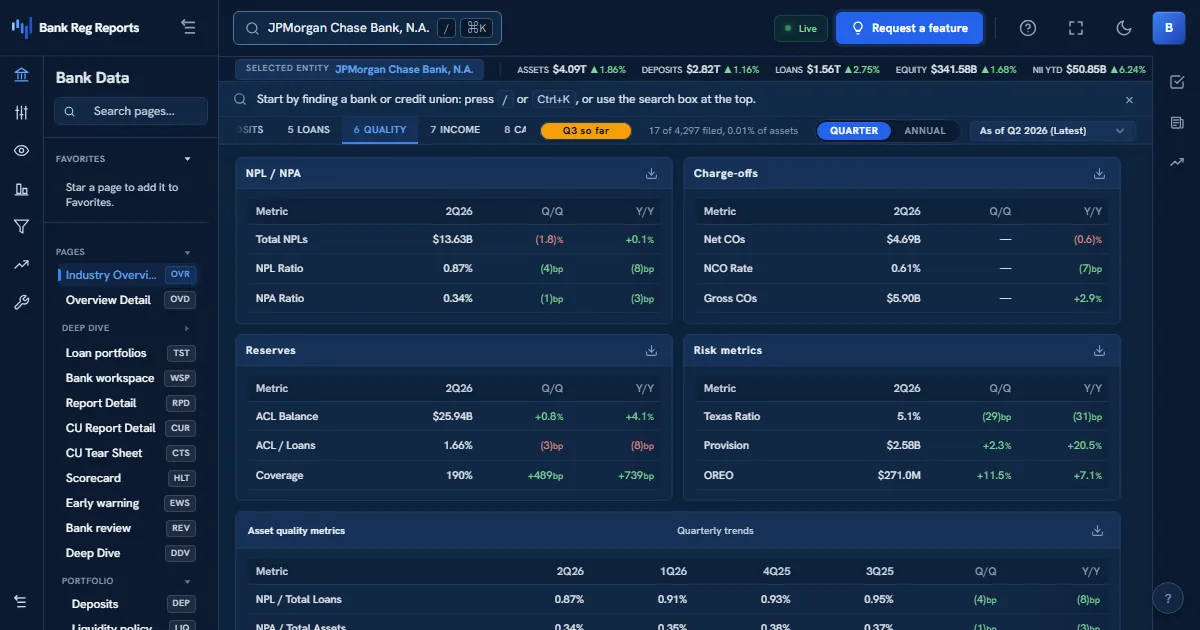
BankRegReports asset-quality view showing NPL and NPA ratios, charge-offs, reserve coverage, the Texas Ratio, and an NPL trend for a bank.

Risk, compliance, and audit work turns on defensible comparisons: is this ratio normal, or a red flag? BankRegReports gives risk officers, internal auditors, and third-party reviewers an independent source for every FDIC-insured bank: CAMELS-aligned indicators, peer norms, and multi-quarter trends, with the methodology behind each metric published so your findings hold up to scrutiny.

The challenge

  • A risk finding needs peer and national context, and assembling that comparison set by hand is slow.
  • Auditors and reviewers need an independent benchmark, not the client's own numbers.
  • Every figure in a report has to trace back to the underlying regulatory filing.

How BankRegReports helps

CAMELS-aligned indicators

Capital, asset quality, earnings, and liquidity ratios organized the way supervision reads them, with regulatory thresholds where they exist and quarter-over-quarter direction.

See the metrics →

Peer and national norms

Benchmark any institution against standard peer groups or your own custom peers to separate a genuine outlier from sector-wide movement.

Compare peers (sign-in required) →

Citable, documented methodology

Every metric's formula, source schedule, and form-variant handling is published in the glossary, so the numbers in your report reconcile to the FFIEC filing.

Check data freshness →

How risk and compliance teams put it to work

Typical workflows, from the first search to a client-ready or board-ready output.

Give a risk finding independent, peer context

A risk observation needs to be defensible: is this ratio a red flag or normal for the peer set? You benchmark against peer and national norms from an independent source, not the client's own numbers.

  1. Open the flagged metric with its CAMELS-aligned indicators.
  2. Benchmark against standard or custom peers and national norms.
  3. Cite the peer-relative position in the finding.

Support a work paper that traces to the filing

An auditor's work paper has to reconcile every figure to the underlying regulatory filing. You lean on published formulas and source schedules so the numbers hold up on review.

  1. Pull the metric with its glossary formula and source FFIEC schedule.
  2. Confirm it reconciles to the institution's call report and UBPR.
  3. Attach the methodology citation to the work paper.

Monitor a portfolio of institutions for emerging risk

You oversee or review several banks and need to catch deterioration across all of them, not one at a time. You track the CAMELS ratios and trends to see which names are moving.

  1. Open asset quality, capital, and liquidity for each institution.
  2. Compare the multi-quarter trend against peer and national norms.
  3. Escalate the names drifting toward the capital minimums or the CRE concentration screens.

See it in action

The same views you'll work in, on real FDIC-insured banks, refreshed every quarter.

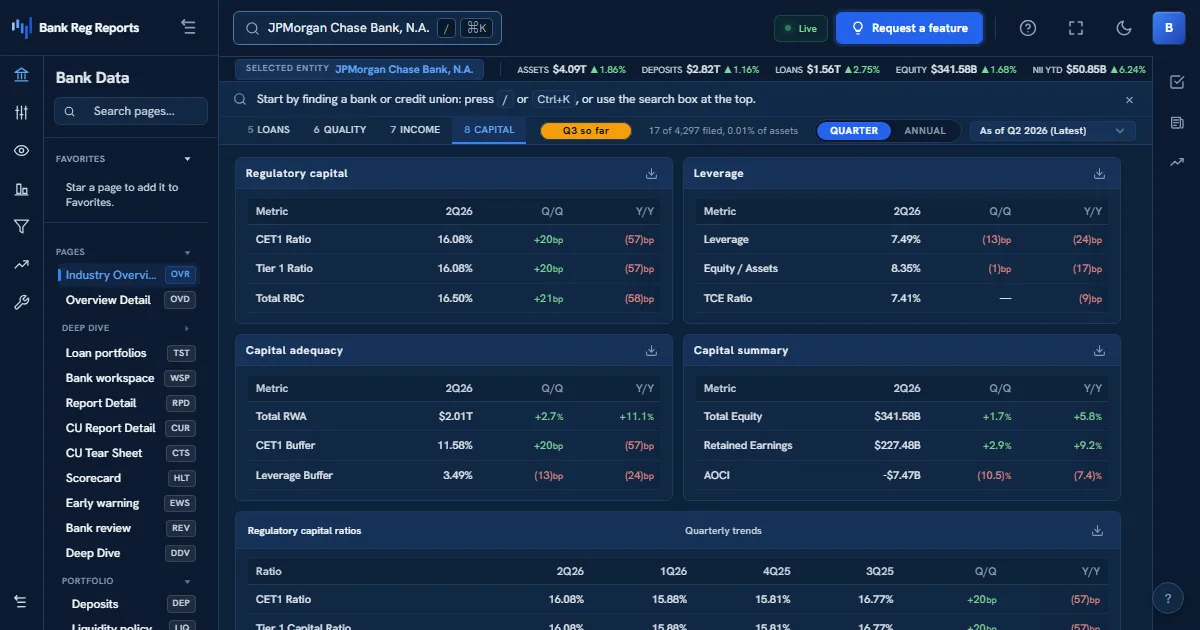
BankRegReports capital view showing CET1, Tier 1 leverage, total risk-based ratios, capital cushions against minimums, and a CET1 trend for a bank.

Capital adequacy, independently sourced

CET1, Tier 1 leverage, and total risk-based ratios against the regulatory minimums with the cushion and trend: an independent, citable benchmark for your risk finding or work paper, reconciled to the FFIEC filing.

See the methodology →

Frequently asked questions

How is the data quality assured?

Every quarterly ingest runs through cross-table consistency, units, and outlier checks before it reaches the platform, so figures reconcile to the underlying FFIEC filings.

Can I cite the methodology in a report or work paper?

Yes. Each metric's definition, formula, source FFIEC schedule, and handling of form variants is published in the glossary, so your calculations are transparent and reproducible.

Is this an independent benchmark I can use in an audit?

Yes. The figures are sourced from official FFIEC filings, not the client's own reporting, so auditors and third-party reviewers get an independent benchmark for any institution against peer and national norms.

Which risk indicators are organized the way supervision reads them?

The CAMELS-aligned set: capital (CET1, Tier 1 leverage, total risk-based), asset quality (noncurrent loans, net charge-offs, reserve coverage, Texas Ratio), earnings, and liquidity, each against peer norms (and, for capital, the regulatory minimums) with quarter-over-quarter direction, so a finding lands in the framework a reviewer expects.
Built for other roles too

See it on your bank

Every FDIC-insured institution, 26+ years of standardized data, one search away.