
Bank data you can quote, on deadline.

Rankings, failure tracking, and per-bank numbers sourced straight from FFIEC filings, with the freshness date you can cite.

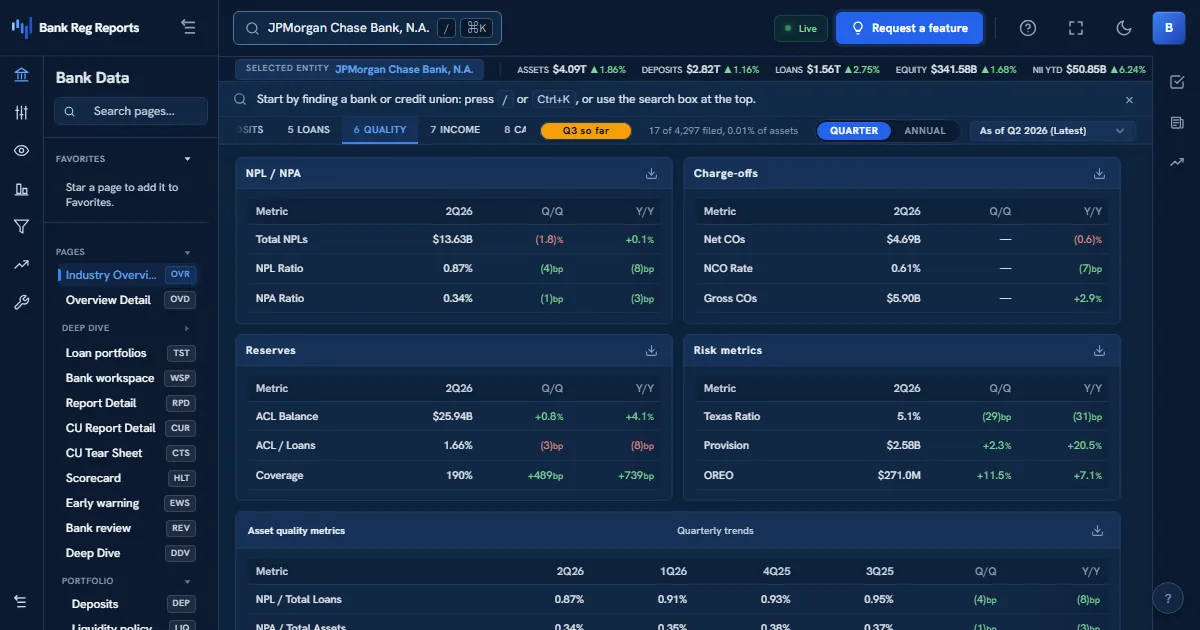
BankRegReports asset-quality view showing noncurrent-loan and NPA ratios, net charge-offs, reserve coverage, the Texas Ratio, and an NPL trend for a bank.

When a bank story breaks, you need numbers you can stand behind before the deadline. BankRegReports puts rankings, per-bank fundamentals, and failure tracking (all sourced from official FFIEC filings) a search away, with a published freshness date so you can cite the data with confidence.

The challenge

  • FDIC and FFIEC portals are slow to navigate under deadline pressure.
  • Readers want context: 'how big', 'how risky', 'compared to whom'.
  • Every figure needs a sourceable, current provenance.

How BankRegReports helps

Rankings & superlatives

Largest banks, highest Texas Ratio, highest uninsured-deposit share, ready-made answers to the 'which bank' questions stories hinge on.

View rankings →

Bank failure tracking

Follow failed and acquired institutions with the regulatory context behind each event.

See bank failures →

Citable freshness

The data updates page states exactly which quarter is loaded and when it refreshed, provenance you can put in print.

Check data freshness →

How journalists put it to work

Typical workflows, from the first search to a client-ready or board-ready output.

Answer 'which bank' on deadline

An editor wants the biggest or riskiest bank for a story, and the FDIC portal is slow to navigate under deadline. You pull the ranking and the number in minutes.

  1. Open the rankings page for the metric the story hinges on.
  2. Sort to the institution the piece needs.
  3. Cite the figure with its reporting period from the Data Updates page.

Add context readers can trust

A single number means little without scale and comparison. You give readers how big, how risky, and compared to whom, each figure sourced to the FFIEC filing.

  1. Open the bank's profile for its size, capital, and asset-quality read.
  2. Benchmark the key ratio against a peer group for context.
  3. Attribute the metric to its published methodology and reporting period.

Follow a bank failure or acquisition

An institution is under stress or has just failed, and you need the regulatory context behind the event. You trace the deterioration and the funding stress that led up to it.

  1. Open the bank failures tracker for the event and its context.
  2. Pull the pre-failure trend in capital, asset quality, and deposits.
  3. Cite the quarter-by-quarter slide with its FFIEC provenance.

See it in action

The same views you'll work in, on real FDIC-insured banks, refreshed every quarter.

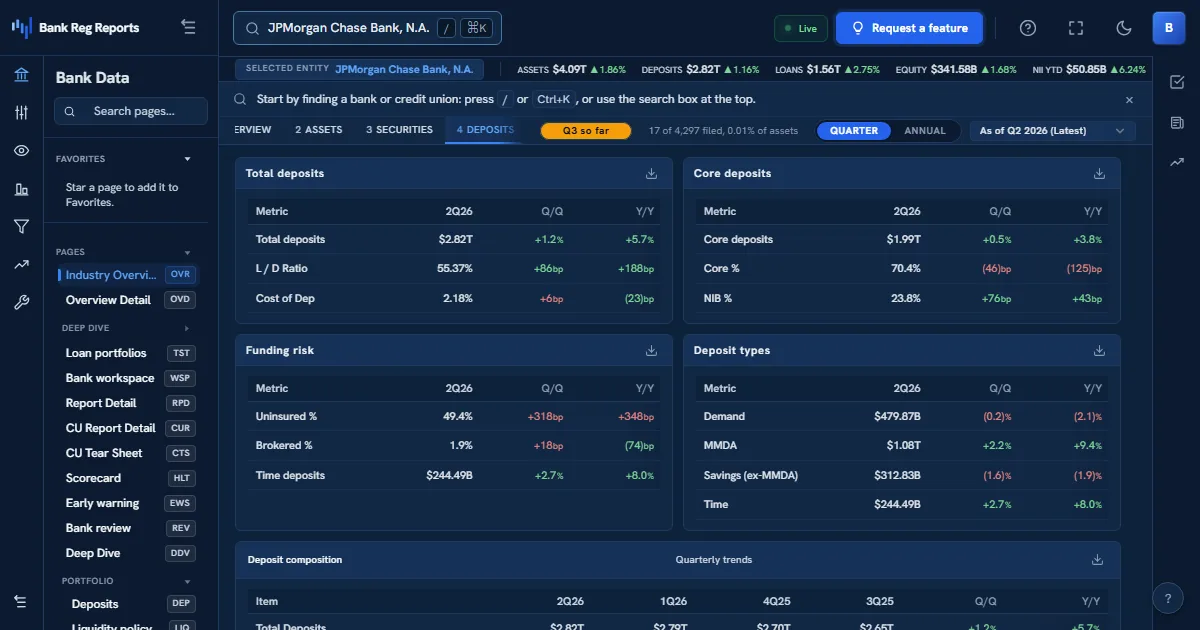
BankRegReports deposits view showing core versus non-core funding, uninsured-deposit share, cost of deposits, and deposit composition for a bank.

Deposit flight, quantified

Core versus non-core funding, uninsured-deposit share, and the deposit-composition trend, the funding-stress angle behind the 2023 regional-bank failures, with a citable freshness date on every figure.

Check data freshness →

Frequently asked questions

Where does the data come from?

All figures derive from official FFIEC call reports for FDIC-insured institutions, and from the UBPR ratios the FFIEC computes from them. The methodology behind each metric is published in the glossary.

How do I know how current a figure is?

The Data Updates page shows the most recent quarter ingested and the date of the last refresh, so you can cite the exact reporting period.

Can I quickly answer 'which bank' questions for a story?

Yes. The rankings and superlatives pages answer the questions stories hinge on (largest banks, highest Texas Ratio, lowest CET1, highest share of uninsured deposits) across every FDIC-insured institution, so you can pull the name and the number in one place.

Is the data free to cite and is there context for readers?

Yes, with attribution. The citation page gives copy-ready citations and the reuse guidelines. Each bank page links to that institution's records at the FDIC and the FFIEC, and every metric has a glossary definition, so you can attribute the source and give readers the 'how big, how risky, compared to whom' context a bank story needs.
Built for other roles too

See it on your bank

Every FDIC-insured institution, 26+ years of standardized data, one search away.